A diamond under poor light looks like glass, and yellow gold under the wrong light looks brassy. Lighting is the cheapest part of a jewelry showcase and the part that most decides whether a piece sells, yet it is usually the last line on the specification. Jewelry display case lighting is the set of light sources built into a showcase — strip, spot and base lighting with their drivers and controls — chosen to show metal colour and stone sparkle accurately without glare. At Elite Fixtures we build the lighting into custom jewelry showcases at the factory, and this guide covers what we ask every buyer to decide before drawings are approved.
Why built-in lighting matters more than ceiling light
Ceiling light alone cannot light jewelry properly. It comes from too far away and from behind the customer, so the customer's own head shadows the tray and the glass top throws back a reflection of the ceiling. Light inside the case starts a hand's width from the product, below the customer's eye line, and does not compete with the room.
That is why the lighting has to be designed with the cabinet, not added to it. Channels for LED strip are routed into the frame, cable runs are hidden in posts and plinths, and the driver needs a ventilated, reachable space. Retrofitting lighting into a finished case almost always leaves visible cables or a hot spot — and a case that has to come apart to reach a failed driver.
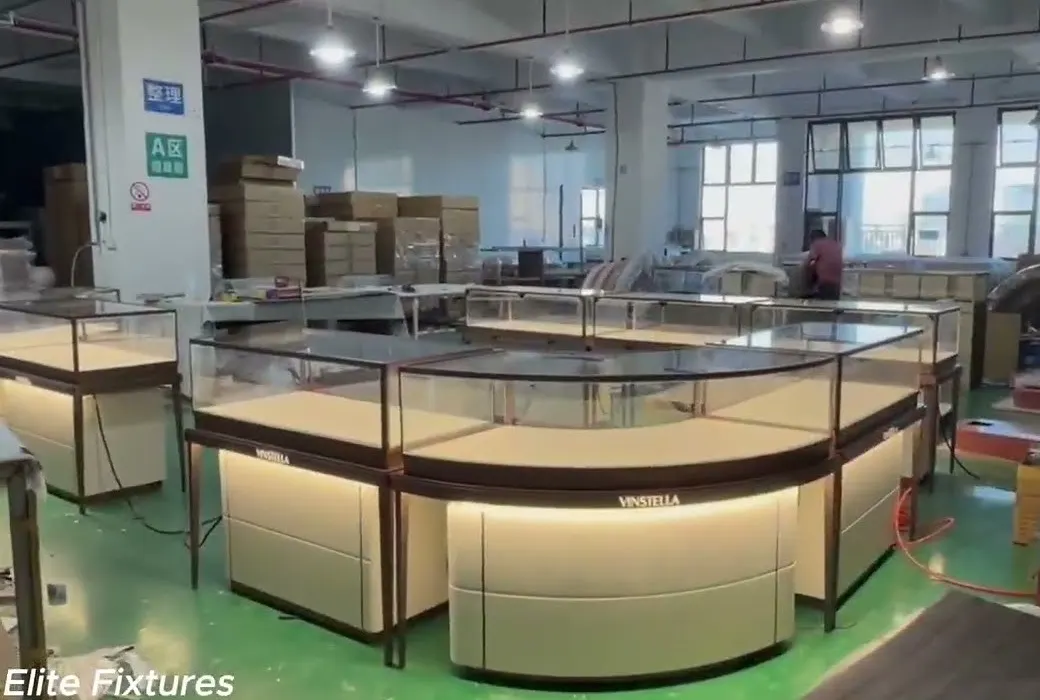
Watch how the base lighting reads on counters still on our factory floor:
Choose the right light sources for each job
A well-lit jewelry case uses two or three kinds of light, each doing one job. Using one kind for everything is the most common mistake we see in competing quotes.
- LED strip in a recessed, diffused channel gives even fill light across the deck, so no tray sits in shadow. It is the base layer for every case.
- Small adjustable spots — on stems ("pole lights") or set into the top frame — give the directional punch that makes stones sparkle. A narrow beam, roughly 15 to 25 degrees, puts light on the piece rather than the glass.
- A lit base or toe-kick makes the counter appear to float and lifts the whole store. It sells the fixture, not the product, so it can be a different, softer light.
- Backlit or edge-lit panels in wall vitrines give a clean, even background for necklaces and earrings.
Our recommendation for most fine jewelry counters is diffused strip plus a few aimed spots along each counter, placed over the trays you most want to sell. Fashion jewelry, which sells on browsing rather than close inspection, can usually run on strip alone. The custom jewelry showcase counter page shows how these sit in one unit.
Understand what case lighting does for jewelry
Light inside a glass case does three jobs, and each one affects the sale.
- It draws the eye. People look first at the brightest thing in a room. A case lit noticeably brighter than the store around it — a common rule of thumb is about three times brighter — pulls customers across the floor to the counter.
- It shows true colour. A customer is deciding whether a stone is the right colour and whether the gold suits them. Light that shifts colour makes them hesitate, and hesitation is a lost sale.
- It makes stones sparkle. A diamond's brilliance and "fire" come from light entering the stone and bouncing back out. Small, concentrated light sources create those flashes; flat, diffused light alone does not.
Why warm, slightly yellow light sells gold
Gold looks rich because it reflects the red and yellow part of the light spectrum and absorbs much of the blue. Warm white LED light, at about 2700K to 3000K, contains more red and yellow, so there is more of the colour gold reflects and the metal glows. Under cool, bluish light there is less of that colour to reflect, so the same yellow or rose gold can look pale, brassy or slightly green.
Warm light also flatters skin. When a customer tries on a ring or necklace and looks in the counter mirror, warm light makes skin look healthy, and the piece looks like it belongs on them. That is why many gold, bridal and heritage jewelers deliberately choose a warmer, slightly yellow light — it is not a lighting mistake but a sales decision.
The trade-off is diamonds and white metals. Under warm light, a colourless diamond can pick up a faint yellow tint, and platinum or white gold looks less crisp. Those pieces read best under neutral to cool white. The answer for a mixed store is either one neutral temperature or a case that can switch.
Get colour right: CRI and colour temperature
Colour rendering decides how honestly a stone and metal read, and that is the purchase decision. The Colour Rendering Index (CRI), defined by the International Commission on Illumination in CIE 13.3, scores how closely a light source shows colours compared with a reference source, on a scale up to 100. For jewelry, specify CRI 90 or above, and ask for the R9 value, which measures saturated red — the score that shows whether rubies, rose gold and skin tones look alive or dull.
Colour temperature, measured in kelvin (K), sets how warm or cool the light looks:
| Colour temperature | Look | Best for |
|---|---|---|
| 2700K–3000K | Warm | Yellow and rose gold, warm wood interiors |
| 3500K–4000K | Neutral | Mixed collections, most stores |
| 4000K–5000K | Cool | Diamonds, platinum, white gold, silver |
Our stance: pick one temperature for the store and keep every case on it. Two temperatures in adjacent cases reads as a fault, not a choice. For a store that sells both gold and diamonds, neutral 3500K to 4000K is the safe middle, or specify tunable-white strip — two LED channels on one strip that let staff move between warm and cool by collection or season from one controller.
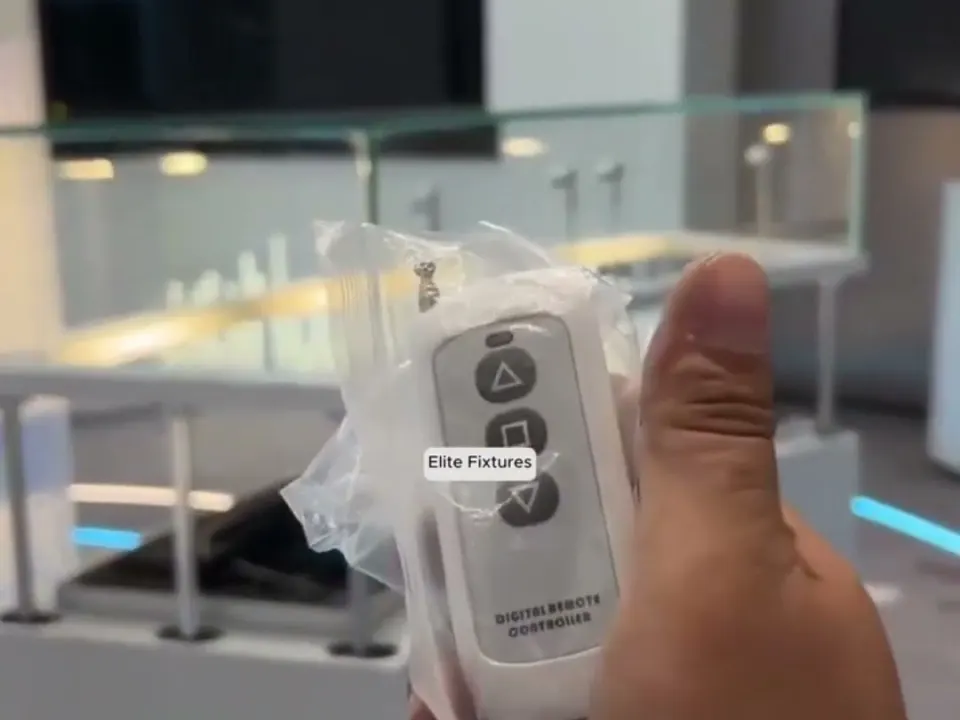
Here is a tunable-white case switching between warm and cool white. Watch how the deck and glass change colour with one control:
With a switchable case, the rule changes from "one temperature for the store" to "one temperature per collection": warm for the gold counter, cool for the diamond counter, set once and left alone during trading.
Plan dimming, drivers and heat
LED cases run on low-voltage DC, usually 12V or 24V, fed by a driver that converts mains power. Drivers are where most lighting problems start, so they deserve a line in the specification:
- Driver location: in a ventilated plinth or service drawer you can reach without removing glass.
- Dimming: a dimmable driver and one controller per counter run, so the run can be balanced against daylight from the window.
- Spares: extra strip and one spare driver from the same production batch, because LED colour drifts between batches.
- Heat: LEDs run far cooler than old halogen showcase lamps, but strips and drivers still warm up. Keep drivers outside the sealed display chamber.
Standard white LEDs emit almost no ultraviolet light, which makes them a safer choice than halogen for pearls, opals and organic materials kept on display all day.
Site power matters as much as the case. On a recent Toronto project the electrical checks cost more than the cabinets — see what really drives LED display cabinet fit-out cost before you set a budget.
Make the lighting work with lifts and adjustable decks
Jewelry cases increasingly move. Adjustable decks change height between collections, and motorized lifts raise a glass hood or a display platform out of the counter at the touch of a button. Every moving part changes the lighting plan: cables have to travel with the moving section, spots must stay aimed when a deck changes height, and lights can be wired to switch on as the display rises.
That is why we draw lighting, movement and locks as one system at shop-drawing stage. Our guide to motorized jewelry display cabinets covers lift types and what to specify.
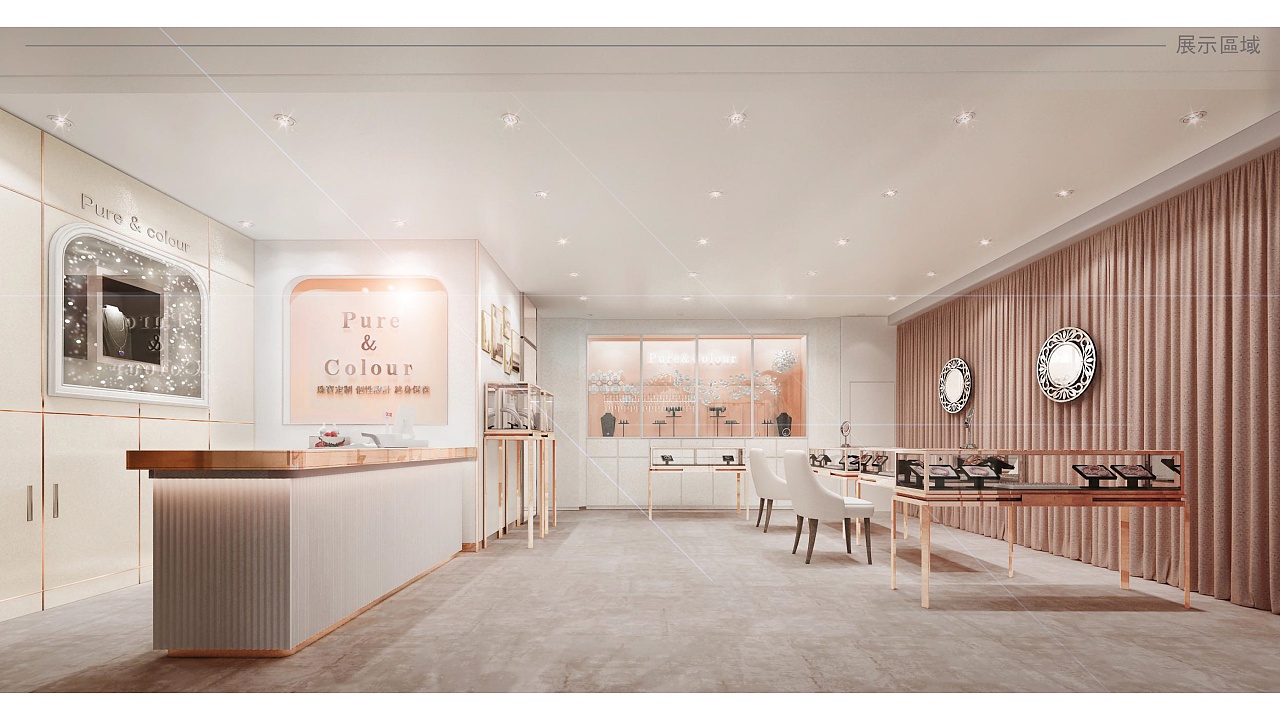
Here is a full boutique — glass counters, wall cases and integrated LED lighting — built around one lighting plan:
What to send for a lighting-ready quote
We build every showcase to the client's sizes and design idea, so the lighting is drawn into the case from the first drawing. To quote accurately, send:
- Case sizes or a floor plan, plus a sketch or reference photos
- The metals and stones you sell, and which category is the hero
- Preferred colour temperature, or whether you want tunable white
- Any lift, adjustable-deck or motorized features
- Finish direction (sprayed lacquer, metal trim, wood veneer) and lock or safe requirements
- Destination city and target opening date
More on the full range is on our jewelry display fixtures page, and stores selling timepieces should also see our watch display fixtures.
FAQ
What is the best lighting for a jewelry display case?
The best lighting for a jewelry display case combines diffused LED strip for even fill light with small, narrow-beam LED spots for sparkle, both at CRI 90 or above. Strip alone makes stones look flat, and spots alone leave shadows between trays. Hide every light source from the customer's eye line so the glass does not glare.
What colour temperature is best for diamonds versus gold?
Diamonds, platinum and white gold look best under neutral to cool light of about 4000K to 5000K, while yellow and rose gold look richer under warm light of about 2700K to 3000K. A store selling both should choose one neutral temperature around 3500K to 4000K, or use tunable-white LED strip that staff can adjust by collection.
Why do jewelry stores use warm yellow lighting?
Jewelry stores use warm, slightly yellow lighting of about 2700K to 3000K because it makes yellow and rose gold look richer and flatters customers' skin when they try pieces on. Gold reflects red and yellow light, so warm light gives it more colour to reflect. Diamonds and white metals look crisper under cooler light, which is why mixed stores often choose switchable lighting.
Can LED lighting be added to an existing jewelry display case?
LED lighting can be added to an existing jewelry display case with surface-mounted strip or clip-on spots, but the result is rarely as clean as built-in lighting. Cables and drivers usually end up visible, and there is no recessed channel to hide the light source. For new showcases, lighting channels, cable routes and driver space should be drawn in at the design stage.
Does LED lighting damage jewelry or gemstones?
LED lighting does not damage jewelry or gemstones under normal display conditions. Standard white LEDs emit almost no ultraviolet light and far less heat than halogen lamps, which makes them suitable for pearls, opals and other sensitive materials. Keeping LED drivers outside the sealed display chamber keeps the inside of the case cool.
Get your showcases lit right from the first drawing
Good jewelry display case lighting comes down to three decisions made early: strip plus spots, CRI 90 or above, and one colour temperature across the store. Get those into the specification and the lighting will sell the product instead of fighting it. Elite Fixtures designs and builds custom jewelry showcases with lighting, finishes, locks and motorized features drawn as one system. Request a quote with your sizes and design idea, and we will come back with drawings and a price.
About this article
The photograph and videos show jewelry showcases built by Elite Fixtures and come from our own factory and YouTube channel. Technical guidance is general; final lighting specifications are confirmed in shop drawings for each project.