For years a jewelry showcase was specified on four things: the finish, the glass, the lock and the safe underneath. Buyers now add a fifth: movement. Glass hoods that rise on a remote, display platforms that come up out of a counter and disappear again at closing, decks that change height between collections. A motorized jewelry display cabinet is a showcase in which an electric lifting mechanism raises and lowers a glass hood, a display platform or the whole display, operated by a remote, a touch switch or a wall button. Elite Fixtures builds them for jewelry stores and for private walk-in closets, and this guide explains the main types and what to put in the specification.
Know the two main types of motorized jewelry display
Almost every motorized jewelry display is one of two layouts, and the choice depends on whether the product should stay on view or be hidden when not in use.
1. Lift-up glass hood. The display deck stays fixed and the glass cover rises on concealed lifting posts, opening a gap so staff can reach in. Lowered, the glass seals onto the base. It suits retail counters and island showcases: the product is always on view, and there is no sliding door or rear access panel to manage.
2. Rising display platform. The jewelry sits on a platform inside the cabinet that rises up through the top — often under its own glass cover — and lowers back out of sight. Closed, the cabinet looks like a plain counter or closet island. It suits private dressing rooms, VIP rooms and anywhere the collection should be hidden when nobody is using it.
Our view: for a retail floor choose the lift-up hood, and for a home or VIP room choose the rising platform. Hiding product on a sales floor costs sales; leaving it on view in a dressing room defeats the point of a concealed piece.
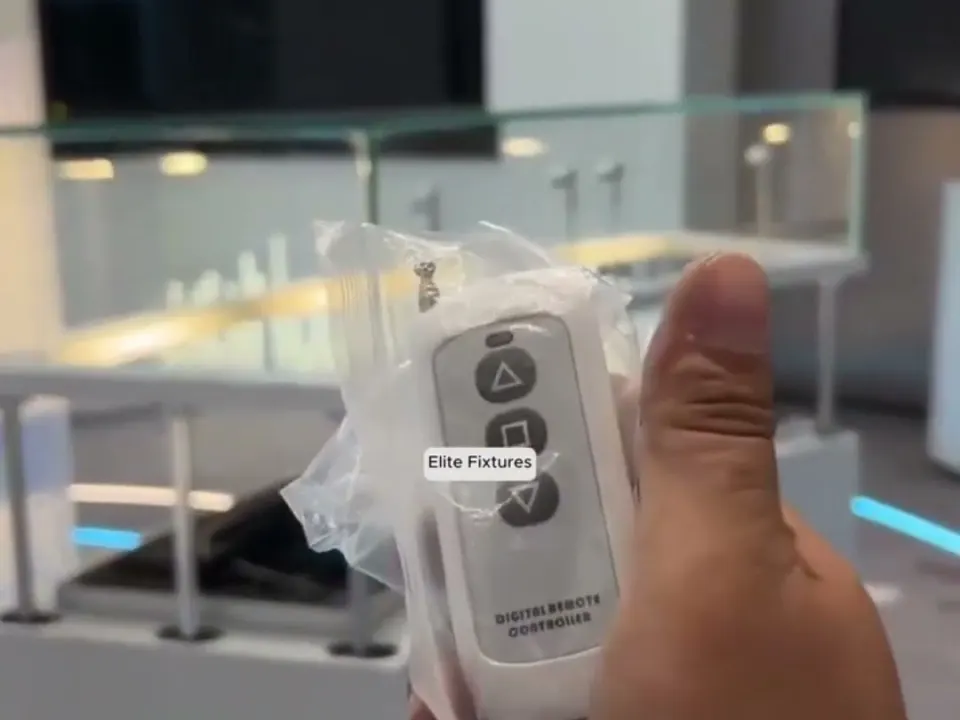
The remote in this clip raises and lowers the glass hoods of a run of showcases:
Design the lift, lighting and lock as one system
A motorized cabinet is three systems sharing one carcass, and most problems come from drawing them separately. We draw them together at shop-drawing stage, and these are the points we settle with every client:
- Lighting that moves with the display. LED strip and spots on a rising platform need cables that travel with it. Lights can be wired to switch on as the display rises and off as it lowers.
- Locks that match the lift. Decide whether the hood or platform locks mechanically when lowered, and who holds keys. Keying is cheap on a drawing and slow on a delivered cabinet.
- A safe where the stock sleeps. A motorized display controls access during use; it is not a safe. If stock stays in the cabinet overnight, we build the cabinet around a safe you or your insurer specify.
- Service access. The lifting mechanism and control box need a panel you can open without removing glass or stone.
For the light itself — CRI, colour temperature, strip versus spots — see our jewelry display case lighting guide.
Specify the details that decide reliability
Motorized cabinets fail at the details nobody wrote down. Before you approve drawings, make sure the specification answers these questions:
- What does it lift? Glass weight plus trays plus product, so the mechanism is sized with a margin rather than at its limit.
- How far and how fast? Lift travel decides cabinet height; a slow, smooth speed looks deliberate, while a fast lift looks cheap and can startle.
- How is it controlled? Remote, touch switch, wall button, or more than one. Retail staff usually prefer a remote; homeowners often prefer a hidden touch switch.
- What happens if it meets an obstruction or loses power? Ask how the mechanism behaves if a hand or object is in the way, and how the display is lowered or opened in a power cut.
- Where does the power come from? One outlet per cabinet, located before the floor or millwork is finished.
We assemble and test each lift in the factory before crating, so the cabinet arrives already working rather than being adjusted on site.
Match the finish to the movement
A motorized cabinet still lives or dies on its finish. Sprayed, baked lacquer gives the deep, seamless surface most luxury jewelry and closet projects want, in gloss or matte, and can be matched to a colour reference. Stainless steel or metal trims protect the edges that people touch. Mirror inside a closet island or behind a rising display doubles the light and shows the back of a piece without lifting it.
Two practical cautions. Gloss lacquer shows fingerprints, so keep it off surfaces that are touched every day, such as the area around a touch switch. And the moving section's gaps must stay tight and even, which is easier to hold on a precisely sprayed carcass than on a site-painted one.
Retail counter or walk-in closet island?
The same mechanism serves two very different buyers, and the specification shifts with each.
Jewelry stores and boutiques need durability over thousands of cycles, keyed-alike locks across a run, consistent light from case to case, and a design that fits the custom jewelry showcase counter module the rest of the store uses. A motorized hero island near the entrance is a strong draw without motorizing every counter.
Homeowners and designers building a walk-in closet usually want a centre island that hides its contents: drawers with velvet trays, a rising lit display for necklaces and watches, mirror details, and a concealed safe. Here quiet operation and a flawless lacquer finish matter more than cycle count. Watch collectors should also look at our watch display fixtures.
From your sizes to a working cabinet
Every motorized cabinet we build is made to the client's sizes and design idea. The process runs in five steps:
- Brief: you send dimensions or a floor plan, a sketch or reference photos, and what the display will hold.
- Drawings: we produce shop drawings showing the lift, lighting, locks, power points and finish.
- Approval: you approve drawings and finish samples; lead time is confirmed at this point.
- Production and testing: the cabinet is built and the lift tested in our factory in Huizhou, China.
- Delivery: crated and shipped, with installation by our own team in the Greater Toronto Area.
See our factory page for how cabinets are built and packed, and our jewelry display fixtures page for the full category.
FAQ
How does a motorized jewelry display cabinet work?
A motorized jewelry display cabinet uses an electric lifting mechanism, controlled by a remote, touch switch or wall button, to raise and lower part of the cabinet. In a lift-up design the glass hood rises so staff can reach the jewelry; in a rising-platform design the display comes up through the top of the cabinet and lowers out of sight when closed.
Is a motorized jewelry display cabinet secure?
A motorized jewelry display cabinet controls access during use, but it is not a safe. Security comes from the lock on the lowered hood or platform, the keying plan, glass specification and, where stock stays inside overnight, a safe built into the cabinet. Elite Fixtures builds the cabinet around the safe and lock requirements set by the owner or the owner's insurer.
Can a motorized lift be added to an existing jewelry cabinet?
A motorized lift can rarely be added well to an existing jewelry cabinet. The mechanism needs depth below the display, a reinforced carcass, a power supply, cable routes for lighting and a service panel, and few standard cabinets have that space. A motorized jewelry display works best when it is designed into a new cabinet from the first drawing.
How much does a motorized jewelry display cabinet cost?
A motorized jewelry display cabinet has no list price because each one is built to size. Cost depends on the cabinet size, the lift type and the weight it carries, glass specification, lighting, the finish such as sprayed lacquer or metal trim, locks or a built-in safe, and quantity. Send sizes and a design idea to Elite Fixtures for a priced drawing.
Bring your idea and your sizes
A motorized jewelry display cabinet is worth it when the movement serves the product: a lift-up hood for a retail hero piece, a rising platform for a private closet. Specify the lift, lighting and lock as one system, write down the load, control and power-cut behaviour, and test it before it ships. Elite Fixtures builds custom motorized cabinets to your sizes and design idea, from a single closet island to a full store. Request a quote with your dimensions and reference images.
About this article
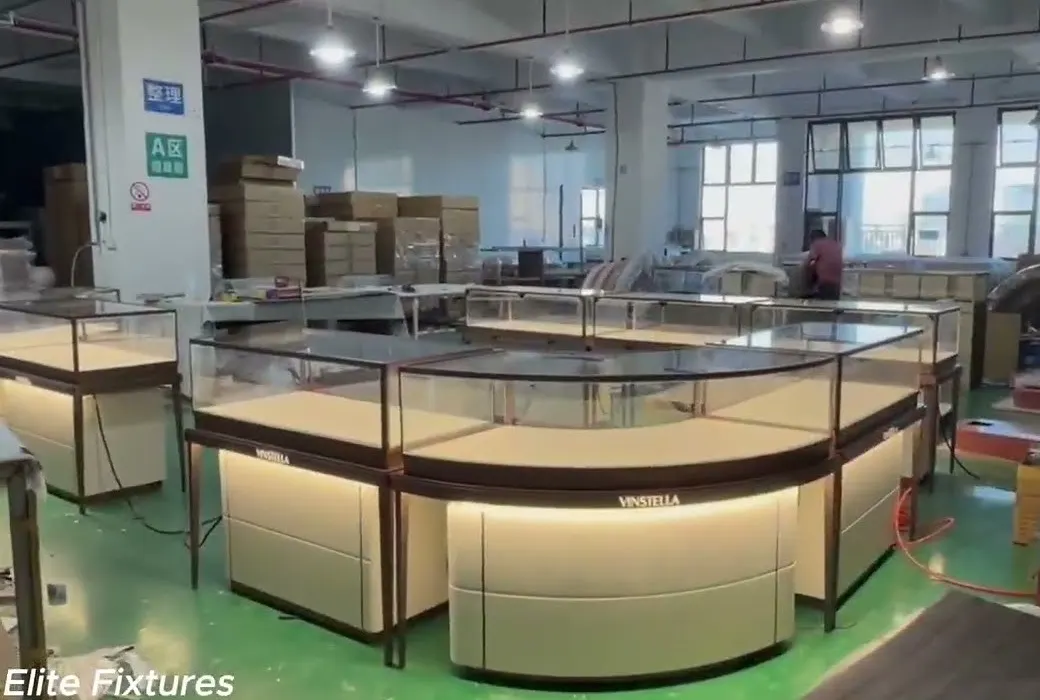
The photograph and videos show motorized cabinets and showcases built by Elite Fixtures and come from our own YouTube channel. Mechanism details vary by project and are confirmed in shop drawings.