
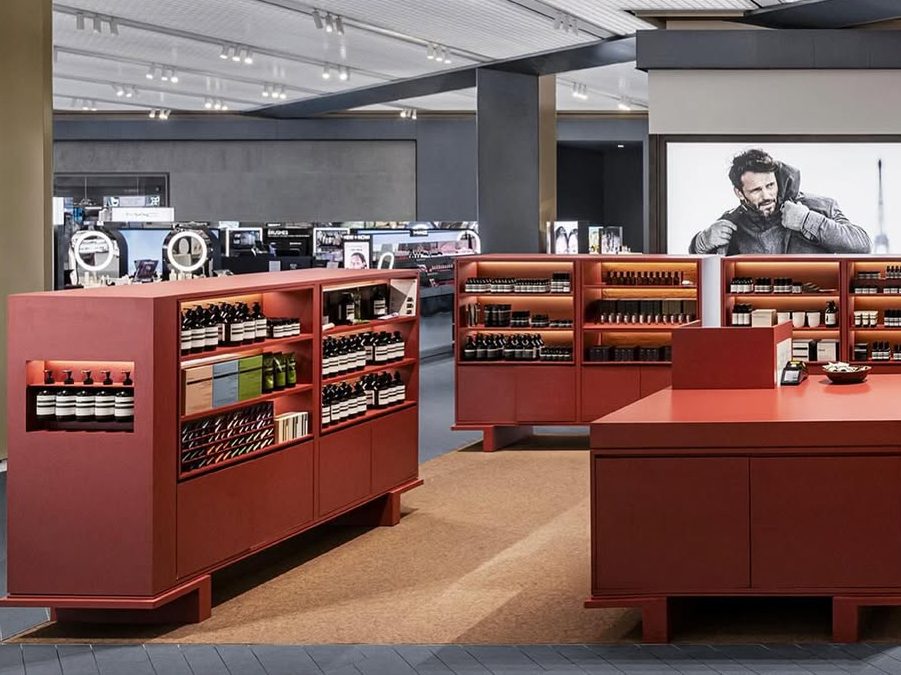
Planning tester capacity and the browse path
Fragrance retail has a specific problem: the customer has to pick up and spray a tester, and every tester they touch has to go back in the right place. So the layout is planned around handling, not just around how many bottles fit. Count testers separately from boxed stock and give each its own zone, because mixing them makes the display look like a stockroom and slows replenishment.
Tester bottles need room around them. A shelf packed edge to edge looks full and sells badly, because customers will not reach into a tight row for fear of knocking neighbours over. Allow enough clearance that a hand can lift a bottle straight up without contact. Deep shelves also invite testers going back in the wrong row, so 250 mm to 350 mm usually works better than 400 mm.
Height matters for a product people pick up. Keep the tester zone between roughly 900 mm and 1500 mm from the floor; above that, a customer reaching over bottles is how breakages happen. Boxed stock and hero display can go higher. The full range is in our perfume showcase category.
- Separate zones: testers, boxed stock, hero or launch display
- Tester shelf depth 250-350 mm, single row, generous side clearance
- Tester zone at 900-1500 mm from floor for easy handling
- Include a bin or tray for used blotters at the tester point
Surfaces that survive fragrance and alcohol
This is the detail that separates a fragrance fixture from a generic display case: perfume is alcohol, and alcohol attacks finishes. Overspray lands on the shelf, runs down the front, and sits there until someone wipes it. A finish that is fine elsewhere in a store will cloud, soften or lift in a tester zone within months.
For tester surfaces we use materials that shrug it off. Glass shelves with polished edges are the most resistant and easiest to keep clear. Acrylic trays are second best and can be lifted out and washed. Laminate and melamine handle wiping well. Sprayed lacquer and real veneer belong away from the spray zone, on vertical brand panels and cabinet fronts where overspray does not pool.
Design for the spill too. A tester tray with a raised lip contains a knocked-over bottle instead of letting it run into the lighting channel or down the cabinet face, and a removable tray can be washed in the back room during a quiet hour.
Lighting glass bottles without hot spots
Perfume bottles are transparent, faceted and often coloured, which makes them the most rewarding thing in retail to light and the easiest to light badly. Light passing through a bottle gives the colour depth; light bounced off the front just shows a reflection of the fitting.
Backlighting and edge-lighting work best. An LED strip in a channel at the back or under a glass shelf sends light through the bottles and makes the liquid glow. Add a diffused fill strip along the front lip so labels stay readable, and shield any accent spot so its source is not visible in the bottle face.
Colour temperature from 2700K to 3500K suits most fragrance concepts: 2700K to 3000K is warm and works with gold trim, amber juice and wood, while 3500K is more neutral for clean modern brand worlds. Keep one temperature across the fixture and match it to nearby beauty fixtures such as our beauty tester wall display system. Drivers go in a ventilated base section with service access, not sealed inside the cabinet.
Boxed stock storage and replenishment
Behind every tester is a stack of boxes, and where those boxes live decides how fast the fixture restocks. Under-counter cabinets and drawers are the usual answer, on soft-close, full-extension runners so staff can see the back of a drawer when looking for one SKU among forty similar boxes.
Size the drawers to the boxes. Fragrance cartons vary widely in height, so a single drawer depth wastes space. Two or three drawer heights in one bank, or adjustable dividers, gets far more stock into the same cabinet. Tell us the largest and smallest carton in the range and we plan the bank around them.
Lockable storage is worth specifying, since fragrance is a high-shrinkage category and boxed stock at floor level is easy to lift. Cam locks are the baseline and tubular locks the sensible upgrade. Keep one unlocked drawer for bags, blotters and cleaning supplies so staff are not unlocking a cabinet twenty times a day.
Brand panels, mirrors, and launch zones
Fragrance sells on brand imagery, and the imagery changes with every campaign. Design graphic panels as replaceable from the start: a rebate that takes a printed panel, a magnetic or clip-in frame, or a lightbox with an accessible face. A panel glued in place means the whole fixture looks dated the moment the campaign ends.
Backlit panels need a driver and a service route planned with the panel, not after it. If a campaign panel changes quarterly, whoever swaps it should be able to do so in minutes without tools, so say at drawing stage how often panels change and who changes them.
A hero or launch position is worth building in: a raised plinth, a lit niche, or a bay set slightly forward of the run. It gives the store somewhere to put a new release without disassembling the main display. Mirror details work well in fragrance because they double the apparent bottle count, but keep mirror out of the immediate spray zone where it shows every mark.
Cleaning, shipping, and what to send for a quote
Tester zones need wiping at least daily and more often on a busy weekend. Glass shelves and acrylic trays take a microfibre cloth with cleaner sprayed onto the cloth; acrylic scratches more easily than glass, so avoid abrasives and paper towel, which hazes a tray over a few months. Wipe the cabinet face below the tester shelf in the same routine, because that is where overspray runs, and empty blotter bins daily. Keep spare LED strip and a driver from the original order, since matching a batch later is unreliable. Other operating questions are on our FAQ page.
Showcases ship fully assembled where size allows, with glass, lighting and hardware fitted and tested. Each unit is foam-wrapped, corner-protected and crated in a wooden export crate; loose glass shelves travel in a dedicated crate with interleaving and acrylic trays are wrapped separately because acrylic marks against anything abrasive. We build in Huizhou, China, and most North American orders go by sea freight - our factory page shows how units are made and packed. On site the work is uncrating, positioning, levelling on adjustable feet, joining sections and power connection by a local licensed electrician.
For a quote, send the counter or wall dimensions, tester count, how much boxed stock needs storage and the carton sizes, whether you want lockable drawers, your brand panel approach and how often panels change, finish direction and lighting temperature, and the destination city and quantity. Fragrance fixtures are commonly quoted with a cash wrap and beauty fixtures, and for temporary sites with a custom mall kiosk package. Lead time depends on finish, panel artwork and order size, and is confirmed after drawings are approved on our lead time page.