
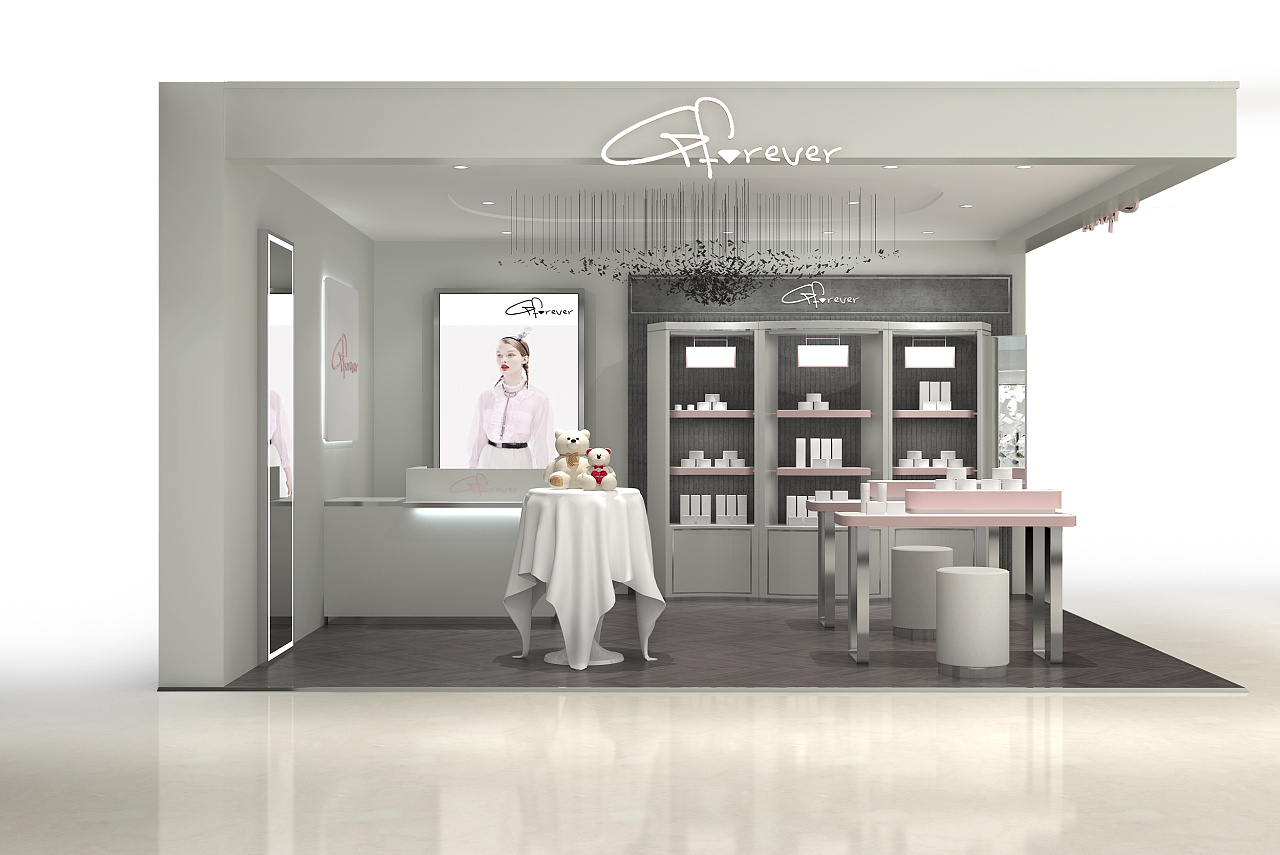
Deciding tester density before the shelves are drawn
The first number we need is how many testers the wall has to carry, because tester positions are the only shelves that people touch every day. A wall planned at forty percent testers behaves very differently from one at ten percent: it needs more reachable height, more wipeable surface and more space for a bin and a tissue box near the action.
Tester zones also want to sit between roughly 900 mm and 1500 mm off the floor. Above that line, customers stop reaching; below it, they stop looking. Boxed stock and backup inventory can live outside that band, which is what lets a beauty wall carry high SKU counts without feeling like a warehouse shelf.
We plan the wall in vertical bays so that a brand or a category owns a full-height strip. Bay widths are kept consistent across the store, which makes later changes cheap. Our other beauty supply store fixtures are built on the same bay module so a wall, a gondola run and a feature table stay in step.
- Tester count per bay and which categories are open for trial
- Reach band for testers, usually about 900-1500 mm off the floor
- Backup stock depth behind or below the display face
- Bay width held constant across the store for future resets
What is behind the face of the wall
A beauty wall is a structure before it is a graphic. We build the back panels in painted MDF or plywood on a levelled cleat system, with a steel upright or slotted standard where shelf loads are high. Cosmetics are light individually and heavy in volume; a 1200 mm shelf full of boxed foundation is not a light shelf.
Shelf adjustability is decided at this stage. A pin-and-hole system gives clean lines and discrete positions; a slotted standard gives finer adjustment and takes heavier brackets. Where the buyer expects frequent resets, the slotted standard usually wins even though the pin system looks better.
Acrylic trays, risers and dividers sit on top of that structure. They are the parts that break, so we keep them to repeatable sizes and make spares easy to order later rather than making every tray a unique part.
Lighting and colour rendering at the tester line
Colour is the product in beauty retail, so the light has to show it honestly. We specify LED strip with a high colour rendering index for tester zones and mirrors, because a customer who chooses a shade under poor light returns it. Low-rendering light makes reds go flat and makes skin tones look grey, which is the single most common lighting complaint in cosmetics stores.
Colour temperature is chosen with the brand, but tester mirrors and the main shelf wash should match. A neutral white around the daylight end of the range is common where customers are matching foundation. Mixing a warm ceiling and a cool shelf light is the fastest way to make a wall look wrong.
Fixtures are recessed into shelf noses or hidden behind a light bar so the customer never sees the diode. Diffusers are used on any strip the customer can look into. Drivers sit in an accessible chase at the top or the base of the wall, not buried behind fixed panels, because drivers are the part most likely to need replacing.
Power for powered testers and mirrors
Heated styling testers, powered devices and lit mirrors all need supply at the wall, and they need it in a place that does not force a cable across a display shelf. We run a concealed chase vertically inside each bay with outlet positions specified per bay, then bring cable out at the tester shelf through a grommet.
Tell us early which testers are powered and roughly how many watts each one draws, and whether you want a switched circuit so the wall can be turned off at closing. All final connection to the building supply is done by a licensed local electrician on site; we build the chase, the outlets' mounting and the cable route, and supply a wiring layout with the drawings.
The same chase carries low-voltage cable for lit graphics. Keeping mains and low-voltage runs separate inside the wall makes later service faster and avoids the tangle that builds up when a store adds testers over two or three seasons.
Spills, sanitation and daily cleaning
Testers leak. Foundation, oils and fragrance all stain, and a porous laminate around a tester shelf will look tired within a season. We specify a non-porous surface at the tester line, usually solid surface, high-pressure laminate with a sealed edge, or acrylic trays that lift out whole for washing at the back of house.
Lift-out trays are the practical answer to sanitation. Staff can take a whole tray to a sink at close instead of wiping around thirty bottles in place. Tray sizes are kept to two or three standards so cleaning rotation is simple and replacements are cheap.
Avoid open joints and unsealed MDF edges anywhere product can drip. Where a shelf must be wood-faced for the look, we seal the edge and set a removable acrylic mat on the shelf face, which takes the abuse instead of the finish. Fragrance testers deserve their own treatment; the approach on our perfume tester display showcase carries over well.
- Non-porous surface at every tester position
- Lift-out acrylic trays in two or three standard sizes
- Sealed edges on any wood-faced shelf near testers
- A planned position for a small bin and tissue at each tester bay
Planogram changes and seasonal resets
Beauty walls get rebuilt more often than almost any other fixture. Brands change, campaign graphics rotate, and shelf heights shift with packaging. A wall that can only be changed with tools and two staff members ends up frozen, and the store loses the flexibility it paid for.
We design graphic panels as separate inserts held in a fixed frame, so a campaign change is a panel swap rather than a fixture change. Shelf pitch is kept to a consistent increment across the whole wall, which means a shelf taken from one bay fits any other bay.
Where the buyer runs multiple stores, we keep a parts list with part numbers for trays, shelves, brackets and graphic panels. Re-ordering fifty shelves for a chain reset is then a line item instead of a new project, and our factory holds the tooling and the finish specification so a repeat run matches the first.
Packing, shipping and what to send for a quote
Wall systems are built and trial-assembled at our factory in Huizhou, China, then packed knock-down. Back panels, shelves and trays ship flat; light bars and pre-wired chases ship as assemblies so on-site work stays limited to fixing, levelling and connection. Every part is labelled to the elevation drawing.
Sea freight to North America is the normal route, and flat packing is what makes a large wall economical to move. Export crating uses heat-treated timber with corner protection on the panel stacks and separate cartons for acrylic, which is the part that suffers most in transit.
For a quote, send wall dimensions with ceiling height, a photo of the wall as it is now, the category list with rough SKU counts, the tester count, and whether any testers are powered. Brand colour references help us price the finish correctly. Lead time depends on wall length, finish and lighting, and is confirmed after drawings are approved; see the lead time guide.