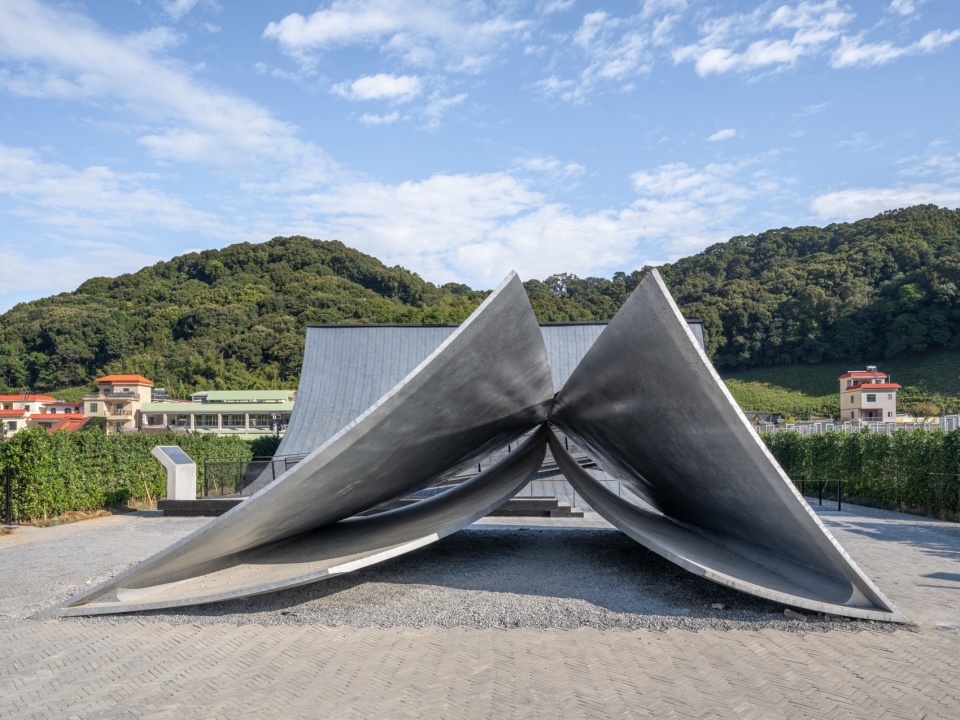
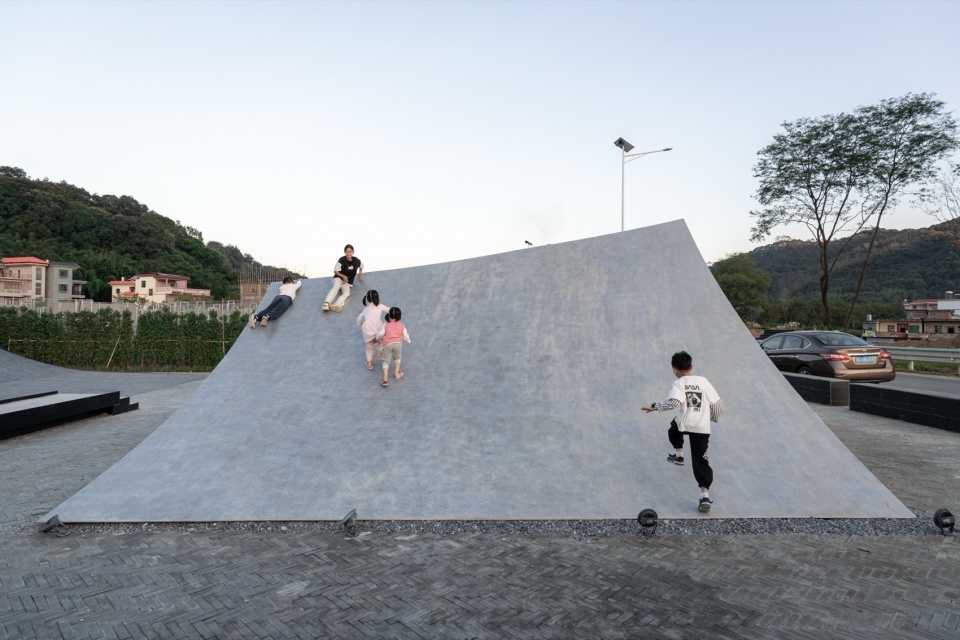
Pages Afloat is a public art installation by the Shanghai studio f-a-n at the entrance to Huizhou Village of Letters in Guangdong, China. Completed in 2025, it is made of four curved stainless steel shells that rise from the ground and meet at a central ridge, like the pages of a book caught mid-turn. The shells carry their own load as a stressed skin, and children climb and slide on them. This article looks at the idea behind the work and how its steel structure was put together.
This is an independent appreciation. Elite Fixtures did not design, fabricate or install Pages Afloat. The work is by f-a-n, and the photographs and drawings are courtesy of f-a-n.
At a glance
| Detail | Information |
|---|---|
| Work | Pages Afloat (浮页) |
| Designer | f-a-n, Shanghai. Design team: Ziyue Liu, Shuai Wang, Wanying Xie |
| Year | Designed and completed in 2025 |
| Location | Riverbank at the entrance to Huizhou Village of Letters, Zhongxin Village, Longmen County, Huizhou, Guangdong |
| Materials | Steel sections, stainless steel plate with an aged surface, concrete foundation |
| Size | About 3 m high on an 8 × 8 m footprint; gross area 60.53 m² |
| Client | Shanghai Fengyuzhu Culture Technology Co., Ltd. |
| Structural consultant | iStructure |
| Photography | Fangfang Tian and Jinquan Kong |
The idea: the moment a page turns
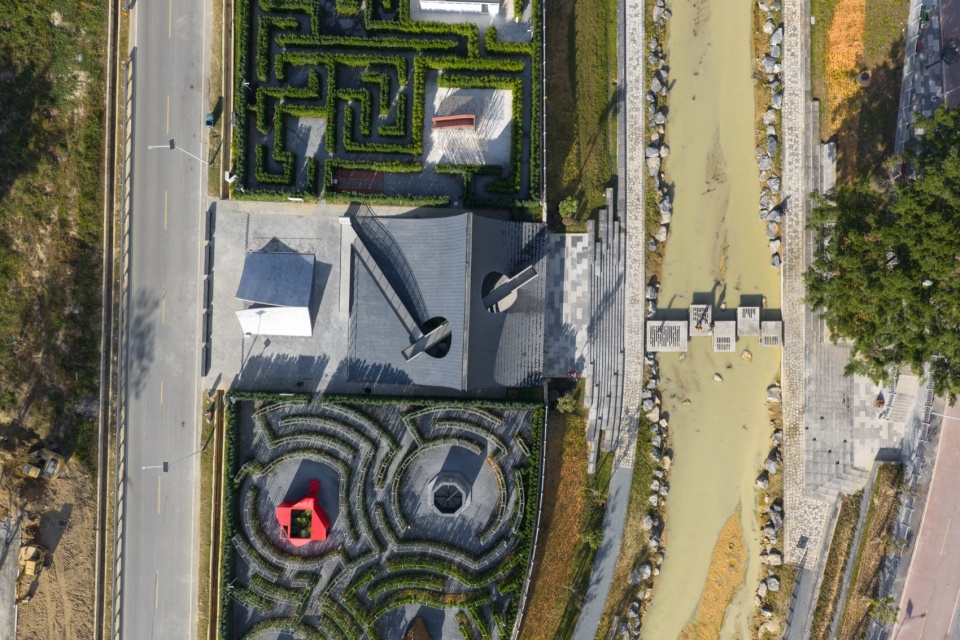
Huizhou Village of Letters is a literary route through a village in the hills of Longmen County, and Pages Afloat is its first stop. The site faces a thousand-year-old banyan tree across the water. The designers chose not to build an image of a book. Instead they abstracted the movement of a page as it turns: four surfaces lift out of the ground, curve upward and meet in a ridge, as if the paper is still in motion.
The architects describe the piece as a threshold rather than a gate or an object. You don't look at it from a distance so much as walk under and around it, and the view of the village opens as you pass through. In their framing, it is the opening chapter of the whole route.
A surface that people can touch
Stainless steel can feel cold and industrial. On Pages Afloat the plates have an aged, weathered texture that softens them. Gooood's write-up compares the surface to a book that many hands have read, and it shifts in tone with the weather and the light. That texture also makes sense for a piece children climb on, because a mirror polish would show every scuff within days.
How the steel shells work
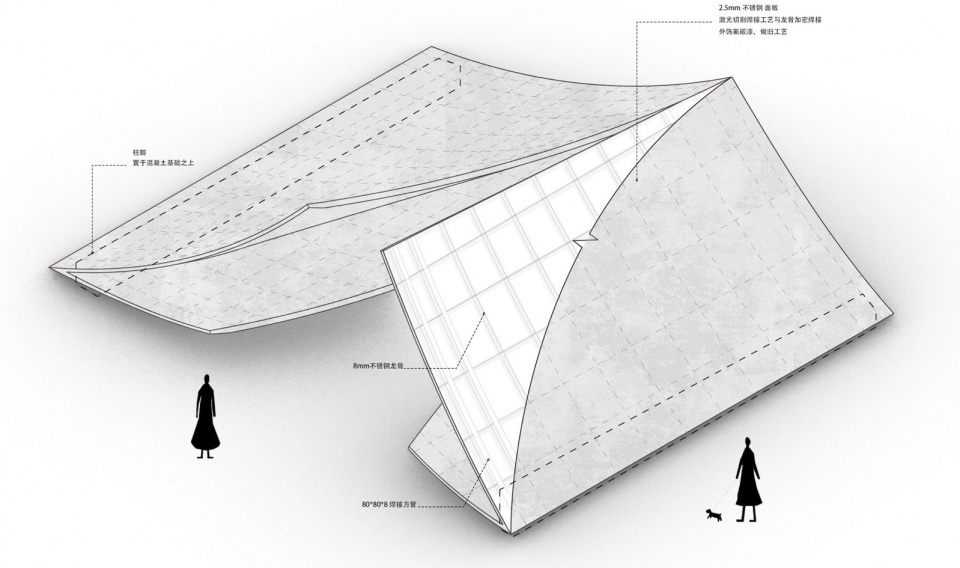
The structural idea is the most interesting part for anyone who builds in metal. The four shells meet at one central core, and each shell works as a stressed skin: the steel plate is not just cladding over a hidden frame, it carries load together with the ribs behind it. According to the architects, the plates cantilever almost 7 m from that core. They also taper from the core toward their edges, which makes the metal look thin, like paper, even though it is doing structural work.
The published construction drawings show how it goes together:
- Face plates: 2.5 mm stainless steel panels, laser-cut and welded.
- Ribs: an 8 mm stainless steel rib frame, densely welded to the face plates so plate and ribs act together.
- Core: welded 80 × 80 × 8 mm square tube members where the four shells meet.
- Finish: a fluorocarbon paint with an aged, distressed treatment on the exterior.
- Foundation: the core sits on a concrete foundation with anchor bars.
These details are read from the project drawings published by f-a-n; the fabricator has not been named.
Why stressed-skin steel is hard to build
From a fabrication point of view, a stressed skin changes the order of work. When the skin carries load, the welds between plate and rib are structural welds, not cosmetic ones, and there are a lot of them. Thin plate distorts as it heats and cools, so the welding sequence has to be planned to keep the curve true. Tapering plates means no two pieces are the same, so each one is cut from the 3D model and fitted in order. And because the shells cantilever from a single core, small errors at the core show up as large errors at the tips.
Pieces like this are usually built in sections in a shop, trial-fitted, and then joined on site, with the final seams ground and finished in place. The aged surface finish helps here too: it hides the small variations that a polished surface would show.
Close to home for us
Huizhou is also where Elite Fixtures has its factory, so Pages Afloat is a piece of contemporary public art in our own city. It is a good example of what Guangdong's design and fabrication community can do with stainless steel when the design, engineering and craft line up.
If you are commissioning a sculptural steel structure
- Decide early whether the skin is structural. A stressed skin can make a lighter, thinner form, but it needs a structural engineer involved from the first model, not after the form is fixed.
- Plan for play. If children will climb it, agree on slopes, edges, grip and fall zones with your consultants during design.
- Choose the finish for the use. A textured or aged finish hides wear; a mirror finish shows everything.
- Budget for trial assembly. Tapered, one-off plates are much easier to fix in the shop than on site.
Elite Fixtures fabricates stainless steel sculpture and playable structures from designs supplied by architects, artists and design studios.
FAQ
What is Pages Afloat?
Pages Afloat is a stainless steel public art installation by the Shanghai studio f-a-n, completed in 2025 at the entrance to Huizhou Village of Letters in Guangdong, China. Four curved steel shells rise to a central ridge to suggest a page turning. About 3 m high on an 8 × 8 m footprint, it doubles as a place for children to climb and slide.
What is Pages Afloat made of?
Pages Afloat is made of stainless steel plate over a stainless steel rib frame, with steel square tubes at its core and a concrete foundation. According to f-a-n's drawings, the face plates are 2.5 mm thick and laser-cut, and the outside has an aged fluorocarbon paint finish that softens the look of the metal.
Who designed Pages Afloat?
Pages Afloat was designed by f-a-n, an architecture studio in Shanghai, with a team of Ziyue Liu, Shuai Wang and Wanying Xie. The client was Shanghai Fengyuzhu Culture Technology Co., Ltd., and iStructure was the structural consultant. The fabricator has not been publicly named.
What is a stressed-skin structure?
A stressed-skin structure is one where the outer surface carries load instead of only covering a frame. On Pages Afloat, thin stainless steel plates are welded to a rib frame so plate and ribs work together, which lets the shells cantilever from a single core while staying visually thin.
Sources
- Pages Afloat / f-a-n architects, ArchDaily
- Huizhou Village of Letters – Pages Afloat, f-a-n on Archinect
- Huizhou Village of Letters – Pages Afloat, gooood
- f-a-n on gooood
About this article
Elite Fixtures was not involved in creating Pages Afloat. We wrote this piece as an appreciation of the work and an explainer on the craft behind stainless steel shell structures. Photographs and drawings are courtesy of f-a-n and are shown with permission.
Interested in working with f-a-n? Contact the studio through f-a-n.cn. Elite Fixtures is a fabrication partner: we build work that architects, artists and designers have already designed, and we don't create original artworks or make reproductions of existing ones. If you have your own concept for a large steel or stainless steel piece, talk to our team about fabrication.