At the plaza by Old Firehall 30, one of the main entrances to Biidaasige Park, a red-orange steel tree holds more than twenty basketball hoops at the ends of its branches. It is Orange Functional by the Cuban artist Alexandre Arrechea, one of the first works on Toronto's new Lassonde Art Trail. Some hoops are low enough for a child's shot and others hang well overhead, and a ball that misses one rim can drop into another on its way down. This article looks at the work, where it came from, and what goes into building steel art that people are invited to play with.
This is an independent appreciation. Elite Fixtures did not design, fabricate or install Orange Functional. The work is by Alexandre Arrechea and was presented in Toronto by the Lassonde Art Trail.
At a glance
| Detail | Information |
|---|---|
| Artist | Alexandre Arrechea (born in Cuba) |
| Work | Orange Functional, 2022 |
| Location | Biidaasige Park, plaza at Old Firehall 30, Toronto |
| Installed in Toronto | June 15, 2026, according to the artist's website |
| Presented by | Lassonde Art Trail |
| Materials | Steel and basketball nets; the 2022 version is listed with Tnemec paint |
| Size | The 2022 version is listed at 17.5 × 24 ft; figures for the Toronto installation have not been published |
| Earlier version | Commissioned by Art Omi in Ghent, New York, in 2022 |
Biidaasige Park and the Lassonde Art Trail
Biidaasige Park is the new waterfront park built as part of the Port Lands Flood Protection project, a $1.4 billion tri-government investment delivered by Waterfront Toronto. The name means "sunlight shining toward us" in Anishinaabemowin. The first 50 acres opened in July 2025 and more parkland followed in 2026. The park is the first public space on Ookwemin Minising, the new island created by the flood protection work.
The Lassonde Art Trail runs through the park for more than four kilometres. It was made possible by a C$25 million gift from Pierre Lassonde and opened its first section in June 2026. The Art Newspaper reported an inaugural group of 17 works, most of them on a rotating basis, with two permanent sculptures to follow. Orange Functional sits at the park entrance, so for many visitors it is the first artwork they meet.
Photographs of Orange Functional by Vid Ingelevics and Ryan Walker are on the Lassonde Art Trail's page for the work.
The idea: a tree that rewrites the game
A regulation basketball court has one hoop at each end, both at the same height, and a fixed set of rules. Arrechea changes all of that. His tree has many rims, at many heights, facing different ways. There is no single target and no obvious way to keep score, so players make up their own game. According to the Lassonde Art Trail, the work presents the hoop as both a sculpture and a social platform, a place where strangers end up playing together.
The tree image carries its own meaning. Balls rise into the canopy and fall back to the ground like ripe oranges dropping from a branch, which is where the title comes from. In an interview with The Art Newspaper, Arrechea compared the work to the choices people make in life: you aim at one place and sometimes end up somewhere else. A missed shot that drops into a lower hoop acts that idea out in a few seconds.
From Orange Tree to Toronto
The work has a long history. Arrechea developed the concept as Orange Tree in 2010, a branching structure with basketball rims at the ends and balls gathered below like fallen fruit. The first fully playable version, Orange Functional, was a commission by Art Omi for its sculpture and architecture park in Ghent, New York, unveiled in June 2022. The fabrication studio 4th State Metals lists that 2022 piece among its projects, credited with the steel, the paint and the full installation.
The Lassonde Art Trail describes the Toronto installation as a new iteration of the work. Who fabricated it has not been published, so we don't guess here.
Why playable steel art is harder than it looks
We build sculptural and playable steel pieces, so we tend to look at a work like this from the fabrication side. None of the details below describe how Orange Functional itself was engineered, because that has not been published. They are the questions any team faces when a sculpture is meant to be touched, climbed on and played with outdoors in Toronto.
People hang on it
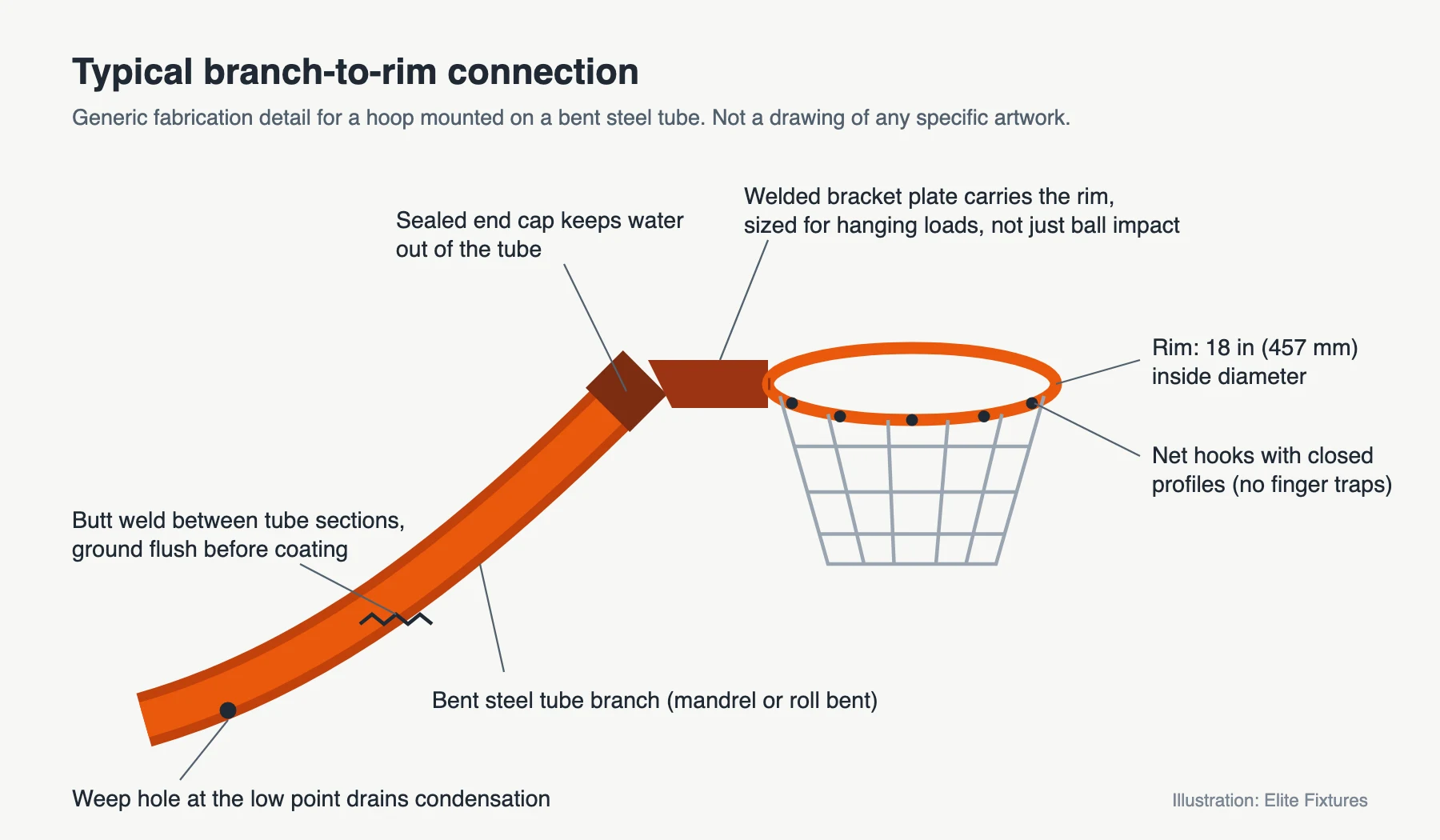
A gallery sculpture only has to carry its own weight and the wind. Once basketball hoops are involved, someone will eventually grab a rim and hang from it. Every rim bracket, branch and weld has to be designed for that load with a margin, and the loads add up along each branch to the trunk and the base.
Every branch is a different curve
Branches like these are usually bent steel tube or pipe. Keeping the bends smooth, joining tube sections without visible seams, and placing twenty-plus rims at the right heights and angles is careful layout and jig work. The layout also has to allow for play: rims need clear space around them so balls and hands don't catch.
The colour has to survive winters and road salt
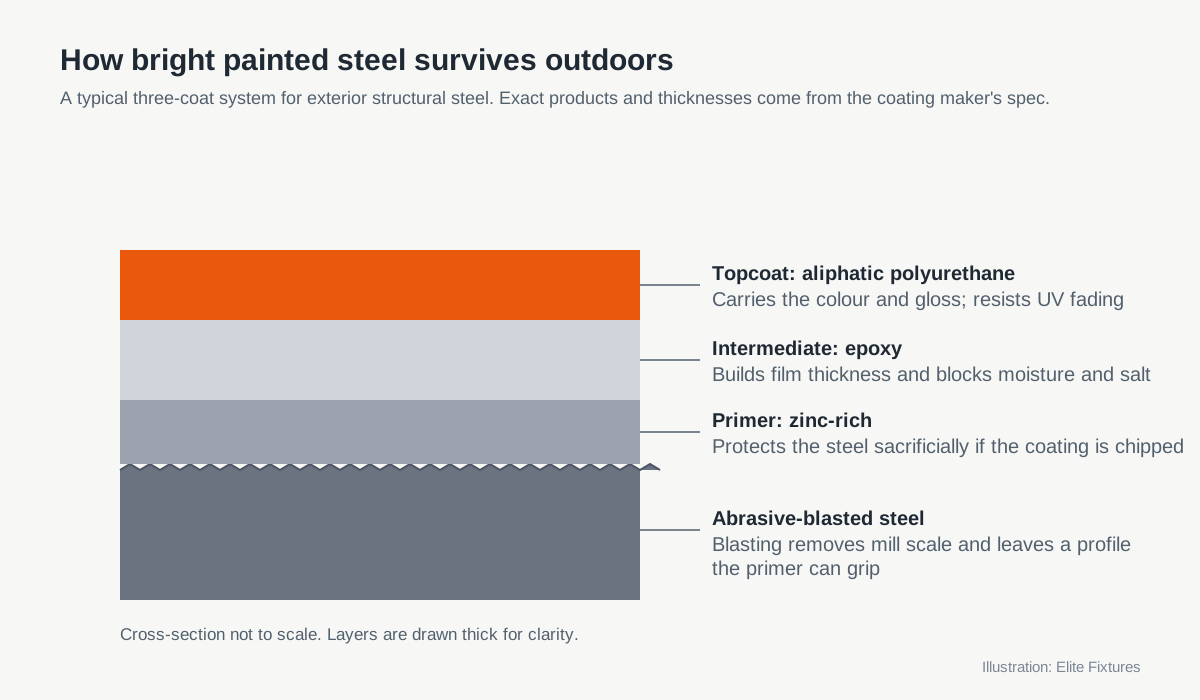
A saturated colour on steel is a coating job, not just a paint job. The 2022 version is listed with Tnemec paint, a maker of high-performance industrial coatings. Outdoors, a durable finish usually starts with abrasive blasting, then a zinc-rich primer, an epoxy intermediate coat and a UV-resistant polyurethane topcoat. On a Toronto waterfront, freeze-thaw cycles, de-icing salt and constant contact from hands and balls all test the coating, and chips need touching up before rust spreads under the paint.
A single trunk carries everything
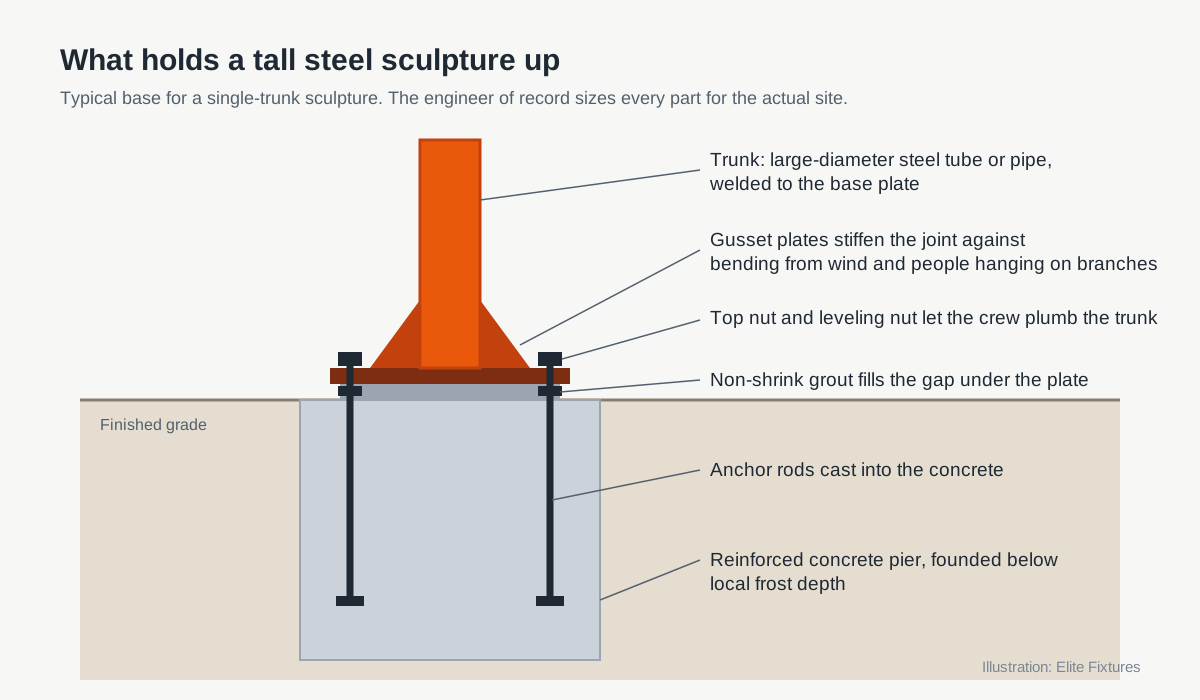
With all the branches coming off one trunk, the base connection does most of the structural work. A typical approach is a base plate welded to the trunk and stiffened with gussets, anchor rods cast into a reinforced concrete pier, leveling nuts to plumb the trunk, and non-shrink grout under the plate. In Toronto the foundation also has to sit below local frost depth. The engineer of record sizes each part for the actual site.
Public play means safety review
When a sculpture invites play, owners usually review it much as they would play equipment: open ends of tubes, gaps that could trap fingers, sharp edges, fall heights and the surface underneath. In Canada, playground equipment is generally assessed against CSA Z614. Whether and how that standard applies to a playable artwork is a decision for the commissioner and their consultants. Either way, the questions are best answered at the design stage, not after fabrication.
If you are commissioning playable public art
Orange Functional shows how much a playable work can do for a public space: it gathers people, it is easy to understand, and it looks good in photos. If you are an artist, designer, developer or municipality planning something in this category, a few points are worth settling early:
- Design loads. Agree on hanging, climbing and impact loads with a structural engineer before the form is finalised.
- Finish system. Specify the coating system, colour and touch-up plan up front, especially for bright colours outdoors.
- Foundation and site. Confirm soil conditions, frost depth and underground services where the piece will stand.
- Play safety. Decide early whether play-equipment standards apply, and design edges, gaps and fall zones accordingly.
- Maintenance. Budget for nets, touch-ups and inspections, because playable work wears faster than work people only look at.
Elite Fixtures fabricates playable, sculptural steel and stainless steel pieces from designs supplied by artists and design studios, and handles custom metal fabrication for Toronto projects. You can see how our factory is set up for this kind of work.
FAQ
Where is Orange Functional in Toronto?
It stands on the plaza at Old Firehall 30, at one of the main entrances to Biidaasige Park in Toronto's Port Lands. It is part of the Lassonde Art Trail.
Who made Orange Functional?
The artist is Alexandre Arrechea, who was born in Cuba. The first playable version was commissioned by Art Omi in 2022, and the fabrication studio 4th State Metals lists that version among its projects. The Toronto installation was presented by the Lassonde Art Trail.
Can you actually play basketball on it?
Yes. The hoops are real and the work is designed to be played. Visitors bring their own balls, and with rims at many heights there is no fixed way to play.
Is Orange Functional permanent?
The Lassonde Art Trail shows many of its works on a rotating basis and has not published an end date for this one. Check the Lassonde Art Trail website before planning a visit.
Sources
- Orange Functional, Lassonde Art Trail
- Lassonde Art Trail / Orange Functional, Alexandre Arrechea
- Alexandre Arrechea: Orange Functional, Art Omi
- Alexandre Arrechea, 4th State Metals
- From beavers to basketball hoops: a new public art trail opens in Toronto, The Art Newspaper
- Alexandre Arrechea grows a playable tree of basketball hoops in Toronto, designboom
- Lassonde Art Trail launches inaugural season, Canadian Architect
- Biidaasige Park, Waterfront Toronto
- The History of Biidaasige Park, City of Toronto
About this article
Elite Fixtures was not involved in creating Orange Functional. We wrote this piece as an appreciation of the work and an explainer on the craft behind playable public art. Photographs of the work can be seen on the Lassonde Art Trail website. The illustrations in this article are our own.
Interested in a work by Alexandre Arrechea? Commissions go directly through the artist: alexandrearrechea.com. Elite Fixtures is a fabrication partner. We build work that artists and designers have already designed; we don't create original artworks or make reproductions of existing ones.
If you are an artist, studio or organization with your own concept for a large-scale steel or stainless steel piece, talk to our team about fabrication.