
The Lassonde Art Trail is a free, open-air route of contemporary art that runs for more than four kilometres through Biidaasige Park, Toronto's new waterfront park in the Port Lands. It opened in two stages in 2026: the east section in June and the west section in July. Fifteen art sites are planned, with works by Canadian and international artists. This guide walks through every work now on the trail, what each one is made of, and what you need to know before you visit.
This is an independent guide. Elite Fixtures is not affiliated with the Lassonde Art Trail and did not make any of the works described here. All works are by the credited artists.
At a glance
| Detail | Information |
|---|---|
| Where | Biidaasige Park, on the island of Ookwemin Minising in Toronto's Port Lands |
| Length | More than 4 km of paths |
| Cost | Free |
| Hours | Open all day, every day, all year |
| Entrances | East: Old Fire Hall 30, 39 Commissioners St. West: 238 Cherry St. |
| Opened | East section June 4, 2026; west section July 24, 2026 |
| Funded by | A C$25 million gift from Pierre Lassonde |
| Run by | The Lassonde Art Trail Foundation |
| Chief curator | November Paynter |
| Map and audio | Trail map (PDF) and a free audio guide on Bloomberg Connects |
A new park built for art
Biidaasige means "sunlight shining toward us" in Anishinaabemowin. The park is the centrepiece of the Port Lands Flood Protection project, a C$1.4 billion investment by the federal, Ontario and Toronto governments that rerouted the mouth of the Don River and protects 430 acres of land from flooding. About 50 acres opened in July 2025 and another 10 acres in July 2026. Waterfront Toronto calls it the largest new park to open in the city in a generation.
The art trail was planned into the park rather than added later. According to The Globe and Mail, the art sites sit on permanent concrete bases with services run underground, and some are wired and plumbed. That lets the trail change works over time: most pieces are on loan and will rotate, with two or three swapped out each year.

The works on the trail
Numbers follow the site numbers on the official trail map. Each title links to the work's page on the Lassonde Art Trail website, where you can see photographs of it.
1. Orange Functional by Alexandre Arrechea
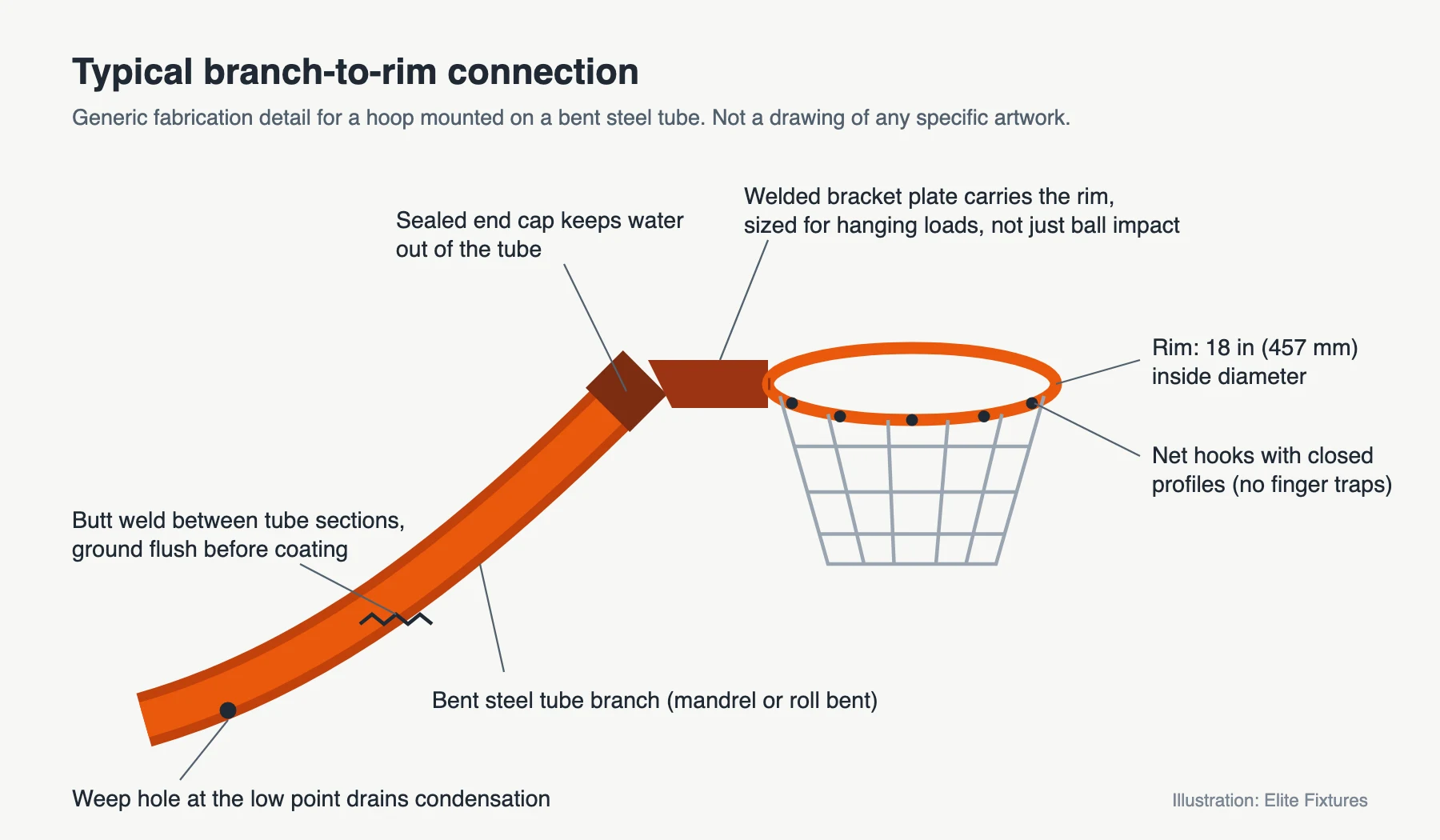
A red-orange steel tree whose branches end in more than twenty working basketball hoops, set at different heights. Bring a ball: the Cuban artist wants visitors to invent their own rules. It stands on the plaza at Old Fire Hall 30, so for many people it is the first work on the trail. We wrote about it in detail in Orange Functional at Biidaasige Park. Official page.
2. Crown Act by Oluseye
A walk-through labyrinth of Accoya wood laid out in the pattern of a braided hairstyle, with a bronze cowrie shell at its centre. It draws on the story of escape routes hidden in braids and on Ontario's place on the Underground Railroad. It sits on an overlook above the new Don River mouth. Official page.
3. Stories of relics by Ryan Gander
Four bronze clocks (an alarm clock, a digital clock, a sand timer and a candle timer) cast so they appear half-swallowed by armourstone boulders. They are spread across the park, so finding all four is part of the work. Official page.
4. Homing by Nadia Belerique and Tony Romano
A stacked dining table, built from everyday objects cast in aluminum and steel, that works like a fountain. From a distance it reads as a strange creature. It is the Toronto artists' first official collaboration. Official page.
5. Roman Standard by Tracey Emin
A small bronze bird perched on a tall pole, a gentle take on the standards Roman legions carried into battle. The pole is steel with a wax and pigment coating. It is on loan from the National Gallery of Canada. Official page.
6. Delicate Matter (for the birds) by Kara Hamilton
Two busts made of cob (straw and mud) holding salvaged brass instruments, on rammed-earth plinths set with beach glass from Lake Ontario. The materials are meant to weather, and a planted vessel of hyssop feeds pollinators. Official page.
7. Trajet by Caroline Monnet and Dean Baldwin Lew
Bronze footprints cast from the feet of Indigenous community members, pressed into clay during a ceremony led by the late Elder Pauline Shirt. The work recalls ancient footprints found in clay on the floor of Lake Ontario, and it sits low at the shoreline so high water can fill the prints. Official page.
8. First Sun by Monira Al Qadiri
A figure about 17 feet tall, part human and part scarab beetle, based on Khepri, the Egyptian god of the rising sun. It is cast aluminum and steel finished in iridescent automotive paint. The work was co-commissioned with Public Art Fund and shown in New York before coming to Toronto. Official page.
9. against the wind, with the wind by Alexa Kumiko Hatanaka
Fish-shaped windsocks in the tradition of Japanese koinobori, flown on five flagpoles above the river mouth. They are modelled on local fish, hand-sewn from ripstop nylon with sail-makers, and some carry ink prints taken from real fish. Official page.
10. The Colony by Kent Monkman
A 12-foot bronze relief of linked figures that visitors can walk through, cast at MST Bronze. It is one of the trail's two permanent sculptures and Monkman's first public art commission. It is scheduled to open on September 30, 2026, on the west side where the Don meets the lake. Official page.
11. Lodestar by Lisa Hirmer
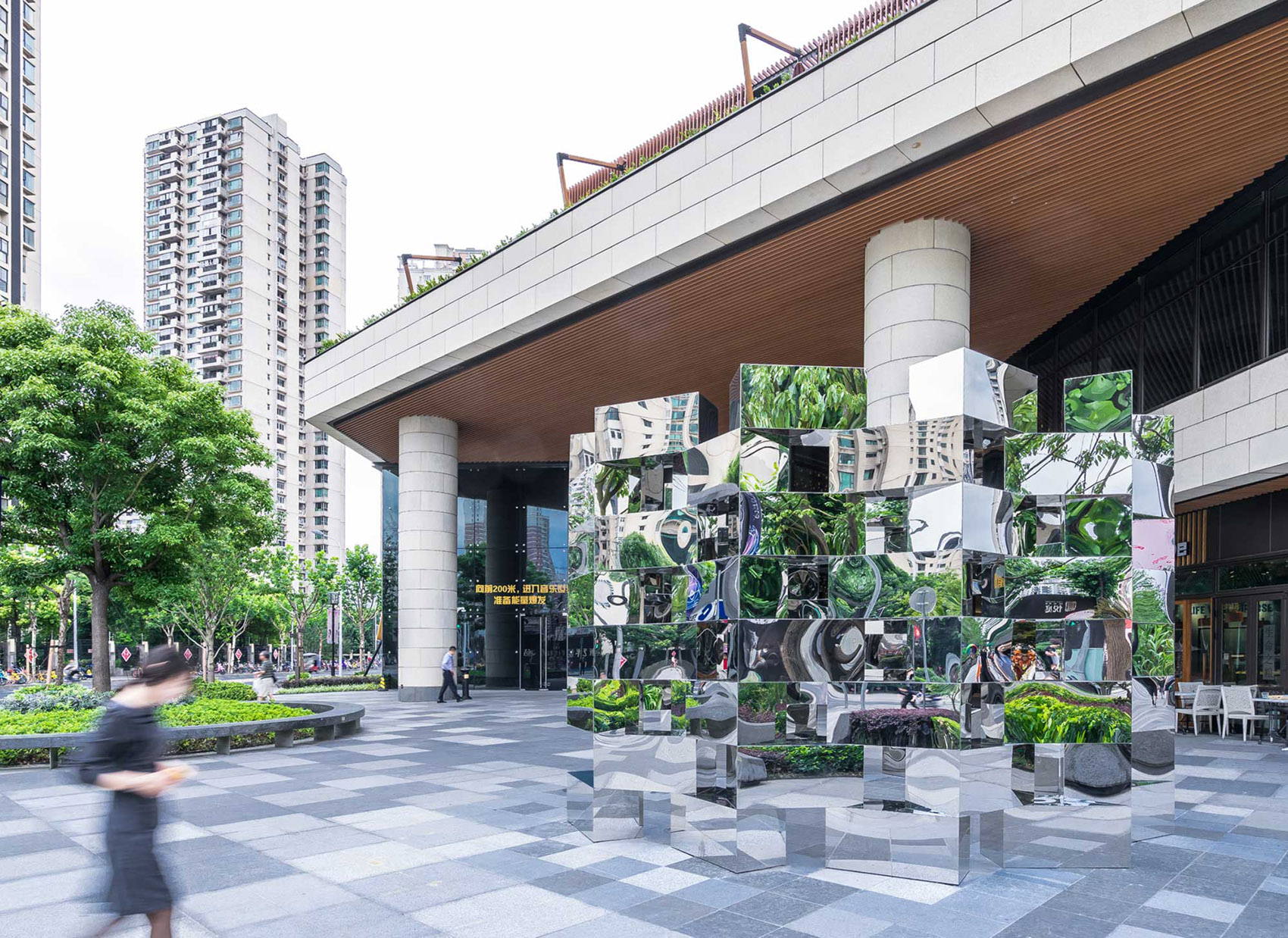
A mirror-finished steel sculpture made of stacked lines of text. The poem traces the site's history, from its glacial past through soil remediation to the flood protection work that made the park. Official page.
12 and 13. Saverio and Daisy (Navel) and Ernest and Ruth (Exuberant Pink) by Hank Willis Thomas
Two bench-sculptures in rolled steel and enamel paint, shaped like the speech and thought bubbles of a comic strip. Visitors sit inside them, and from the western esplanade they frame the Toronto skyline. Official page for Saverio and Daisy and for Ernest and Ruth.
14. Untitled (Juniper) by Virginia Overton
A working weathervane in painted mild steel with a gilded juniper silhouette, a tribute to the eastern red cedars planted across the park. Official page.
Coming next
Joana Vasconcelos's Artemisa, a permanent tree-like sculpture clad in hand-painted ceramic tiles, is expected in 2027. A new work by Alicja Kwade, developed with the National Gallery of Canada, is planned for spring 2027. See the Artemisa page and the Alicja Kwade page.

What the works are made of
Walk the whole trail and you see most of the materials used in outdoor sculpture today, which is part of what makes it worth the trip for anyone who designs or commissions public art:
- Painted and enamelled steel: Orange Functional, the Hank Willis Thomas benches and Virginia Overton's weathervane. Bright colour outdoors depends on a proper coating system and regular touch-ups.
- Mirror-finished steel: Lisa Hirmer's Lodestar. A mirror surface shows every dent and fingerprint, so flatness and seam quality matter more than on any other finish.
- Cast aluminum and steel: Homing and First Sun. Aluminum keeps large cast forms lighter, and automotive paint gives First Sun its shifting colour.
- Bronze: Stories of relics, Roman Standard, Trajet, The Colony and the cowrie in Crown Act. Bronze is the traditional choice for detailed casting and long outdoor life.
- Wood, earth and textile: Crown Act, Delicate Matter and the Hatanaka windsocks, some of which are meant to change or wear with the seasons.
The Globe and Mail also reported that works on the trail carry a sacrificial anti-graffiti finish and are checked by staff every day. For playable or touchable art in a busy park, that maintenance plan matters as much as the fabrication.

How to visit
- Getting there by TTC: the 114 bus runs along Cherry Street and Commissioners Street, about 15 minutes from Union Station. The 72 Pape bus stops at Saulter Street and Commissioners Street. The trail also suggests the 504 King and 514 Cherry streetcars.
- By bike: the Martin Goodman Trail passes nearby, and there is a Bike Share station at Cherry Street and Commissioners Street.
- By car: a temporary lot at 11 Munition Street has about 120 spaces.
- Time needed: the trail suggests about three hours to see everything. You can start at either entrance.
- Tours and access: free guided tours run on Saturdays, the main paths are fully accessible, and washrooms are at Old Fire Hall 30.
Check the Lassonde Art Trail visit page and the City of Toronto's directions before you go, since transit routes in the Port Lands are still changing.
If you are planning public art
The Lassonde Art Trail shows how a city can plan for art from the start: permanent bases with power and water, a rotation schedule and a maintenance routine. If you are an artist, designer, developer or municipality planning an outdoor work in steel, stainless steel or aluminum, Elite Fixtures can help you fabricate it from your design. See our custom stainless steel fabrication service and our metal fabrication work in Toronto.
FAQ
Is the Lassonde Art Trail free?
Yes. The Lassonde Art Trail is free for everyone, with no tickets and no gates. It is open 24 hours a day, all year, because the works are outdoors in Biidaasige Park. Free guided tours run on Saturdays, and a free audio guide is available through the Bloomberg Connects app.
Where does the Lassonde Art Trail start?
The Lassonde Art Trail has two entrances in Biidaasige Park, and you can start at either. The east entrance is at Old Fire Hall 30, 39 Commissioners Street, next to Orange Functional. The west entrance is at 238 Cherry Street. The full route covers more than four kilometres of paths.
How long does it take to walk the Lassonde Art Trail?
Allow about three hours to see every work on the Lassonde Art Trail, which is the trail's own estimate. The Globe and Mail suggests one to two hours for a quicker visit. The paths run for more than four kilometres through Biidaasige Park, so comfortable shoes and water help on a warm day.
Are the artworks on the Lassonde Art Trail permanent?
Most are not. Most works on the Lassonde Art Trail are loans that will rotate, with two or three changed each year. Kent Monkman's The Colony and Joana Vasconcelos's Artemisa are the two permanent sculptures planned, and both will be gifted to the City of Toronto's public art collection.
How do I get to Biidaasige Park by transit?
Take the TTC 114 bus from Union Station along Cherry Street and Commissioners Street, a trip of about 15 minutes. The 72 Pape bus also stops at Saulter Street and Commissioners Street, and a seasonal water shuttle stops at 242 Cherry Street. Check the City of Toronto's directions page before you go, as Port Lands routes are still changing.
Sources
- Lassonde Art Trail: home, about, visit and artwork pages
- Waterfront Toronto: Biidaasige Park
- Waterfront Toronto: Toronto's largest park in a generation just got bigger
- City of Toronto: The History of Biidaasige Park
- City of Toronto: How to get to Biidaasige Park
- CBC Arts: Lassonde Art Trail preview
- The Globe and Mail: Toronto's Lassonde Art Trail represents public art done right
- The Art Newspaper: From beavers to basketball hoops
- Canadian Architect: Lassonde Art Trail launches inaugural season
- SURFACE: The Lassonde Art Trail is now open
About this article
Elite Fixtures is not affiliated with the Lassonde Art Trail and did not design or make any of the works described here. We wrote this guide as an appreciation of the trail and its artists. Photographs of the park are from Wikimedia Commons under the licences credited in each caption; photographs of the artworks can be seen on each work's official page, linked above.
Interested in commissioning one of these artists? Contact them through the Lassonde Art Trail or the artists' own studios. Elite Fixtures is a fabrication partner: we build work that artists and designers have already designed, and we don't create original artworks or make reproductions of existing ones. If you have your own concept for a large outdoor piece, talk to our team about fabrication.