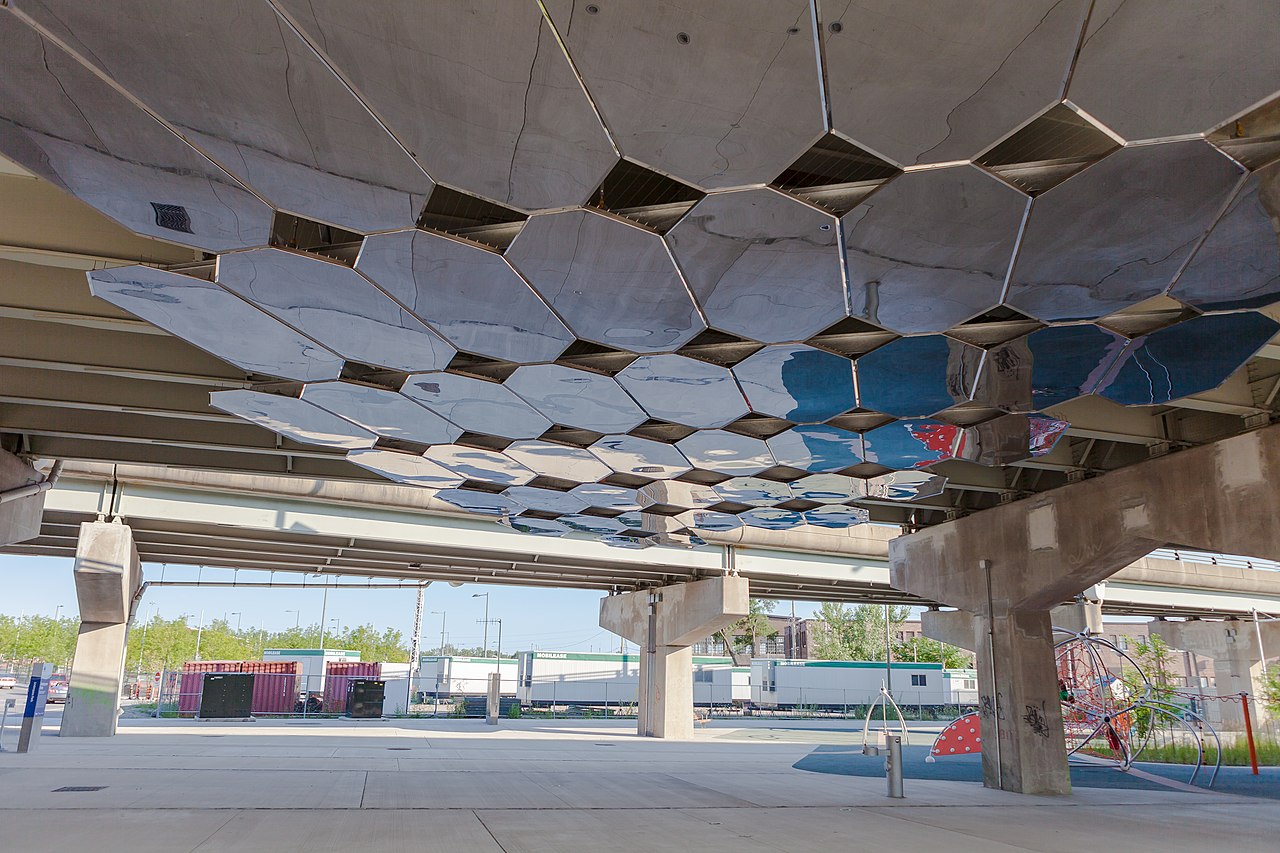
Mirage is a public artwork by the Toronto artist and architect Paul Raff at Underpass Park, a park built beneath the Eastern Avenue and Richmond/Adelaide overpasses in the West Don Lands. Unveiled on August 2, 2012, it covers the underside of an overpass with 57 octagonal, mirror-polished stainless steel panels, so a dark concrete ceiling reflects the park, the sky and the people below. It is a permanent work, but it is currently in storage while the City repairs the bridges above the park.
This is an independent appreciation. Elite Fixtures did not design, fabricate or install Mirage. The work is by Paul Raff Studio and was commissioned by Waterfront Toronto.
Is Mirage on view right now?
Not at the moment. The City of Toronto's page for the Eastern and Adelaide bridge repairs says the mirrored artwork has been removed and safely stored, and will be reinstalled once construction is complete. Work began in July 2024 and is expected to finish in early 2027. Check the City's project page before you visit to see it.
At a glance
| Detail | Information |
|---|---|
| Work | Mirage |
| Artist | Paul Raff Studio, Toronto |
| Unveiled | August 2, 2012, with the first phase of Underpass Park |
| Location | Underside of the overpass at Underpass Park, 29 Lower River Street, Toronto |
| Material | 57 octagonal mirror-polished stainless steel panels |
| Area | About 270 m² |
| Commissioned by | Waterfront Toronto, through its first public art competition |
| Status | Permanent; temporarily removed for bridge repairs, reinstallation expected after early 2027 |
Underpass Park
Underpass Park turns the land under a tangle of highway ramps into a public space. At about 2.5 acres, Waterfront Toronto calls it the largest park built under an overpass in Canada and the first in Toronto. It runs between Cherry Street and Bayview Avenue, with a skatepark, basketball half-courts, a playground and long benches, designed by PFS Studio with The Planning Partnership. The first phase opened in 2012 and the second in 2015, and the park has won an ASLA Award of Excellence and a Toronto Urban Design Award.
The problem every underpass park faces is the ceiling: a heavy, shadowed concrete deck. Mirage was Waterfront Toronto's answer, chosen through its first public art competition.

The idea: bending light into a dark space
The name explains the idea. Large mirror surfaces bend light to produce a displaced image, the way a desert mirage does. Each of the 57 panels differs slightly in size and spacing, so reflections break up and shift as you walk under them, and the line between ground and sky blurs. Critic John Bentley Mays described the effect as imagery hovering like a shining cloud over people's heads.
The work does practical good too. The mirrors bounce daylight into spaces that would otherwise be dim, and they draw people into and through the park instead of around it.

What it takes to hang mirror panels overhead
We fabricate mirror-polished stainless steel, so we look at Mirage from the workshop side. The fabricator and engineering details have not been published; the points below are general to overhead mirror installations.
Flatness is everything
A mirror panel that is even slightly wavy distorts its reflection. Large polished panels are usually made from thicker sheet or backed with a stiffening frame so they stay flat, and the protective film stays on until the panel is in place.
Fixings you don't see
Overhead panels are hung from hidden brackets fixed into the structure above, with adjustment built in so each panel can be set to the right angle and height. Every fixing needs to be designed so a panel can never fall, which usually means redundant fixings and a structural engineer's sign-off.
Built to come down
Bridges need inspection and repair. The fact that Mirage could be taken down, stored and reinstalled shows the value of a fixing system that allows panels to be removed without damage. It is a good lesson for any art mounted on infrastructure.
Keeping it clean
Under a road deck, a mirror collects dust, exhaust residue and water spots. Owners need safe access for cleaning and inspection, which affects how high and how far apart panels can be.

If you are commissioning mirror art on a structure
- Coordinate with the structure's owner early. Bridges and buildings need inspection access, and the art should come down without damage when repairs are due.
- Keep panels flat. Specify sheet thickness or backing frames so the reflection stays true.
- Design fixings for safety. Overhead panels need redundant, engineered fixings and a clear inspection routine.
- Plan cleaning access. Decide how the mirrors will be reached and cleaned before you fix their height.
Elite Fixtures fabricates mirror-polished stainless steel installations and custom metal work in Toronto from designs supplied by artists and designers.
FAQ
What is Mirage at Underpass Park?
Mirage is a public artwork by Toronto artist and architect Paul Raff, unveiled on August 2, 2012, at Underpass Park in Toronto's West Don Lands. It covers about 270 m² of the underside of an overpass with 57 octagonal mirror-polished stainless steel panels that reflect the park and its visitors. Waterfront Toronto commissioned it.
Is Mirage at Underpass Park still there?
Mirage is temporarily removed. The City of Toronto has taken the mirror panels down and stored them during repairs to the Eastern and Adelaide bridges, which began in July 2024 and are expected to finish in early 2027. The City says the artwork will be reinstalled once construction is complete.
Where is Underpass Park in Toronto?
Underpass Park is in the West Don Lands, under the Eastern Avenue and Richmond/Adelaide overpasses between Cherry Street and Bayview Avenue, at 29 Lower River Street. At about 2.5 acres, it is the largest park built under an overpass in Canada, with a skatepark, basketball courts and a playground.
What is Mirage made of?
Mirage is made of 57 octagonal panels of mirror-polished stainless steel, each slightly different in size and spacing, fixed to the underside of the overpass. The mirror finish bends and breaks up reflections as people move below, which gives the work its name.
Sources
- Mirage, Paul Raff Studio
- Public Art Sculpture Mirage / Paul Raff Studio, ArchDaily
- A virtual tour of public art in the West Don Lands, Waterfront Toronto
- Underpass Park, Waterfront Toronto
- Rehabilitation of the Eastern and Adelaide bridges, City of Toronto
- Phase one of Toronto's Underpass Park opens, Canadian Architect
- Underpass Park, PFS Studio
About this article
Elite Fixtures was not involved in creating Mirage. We wrote this piece as an appreciation of the work and an explainer on the craft behind mirror stainless steel installations. Photographs are from Wikimedia Commons under the licences credited in each caption and were taken while the work was installed.
Interested in working with Paul Raff Studio? Contact the studio through paulraffstudio.com. Elite Fixtures is a fabrication partner: we build work that artists and designers have already designed, and we don't create original artworks or make reproductions of existing ones. If you have your own concept for a mirror stainless steel piece, talk to our team about fabrication.