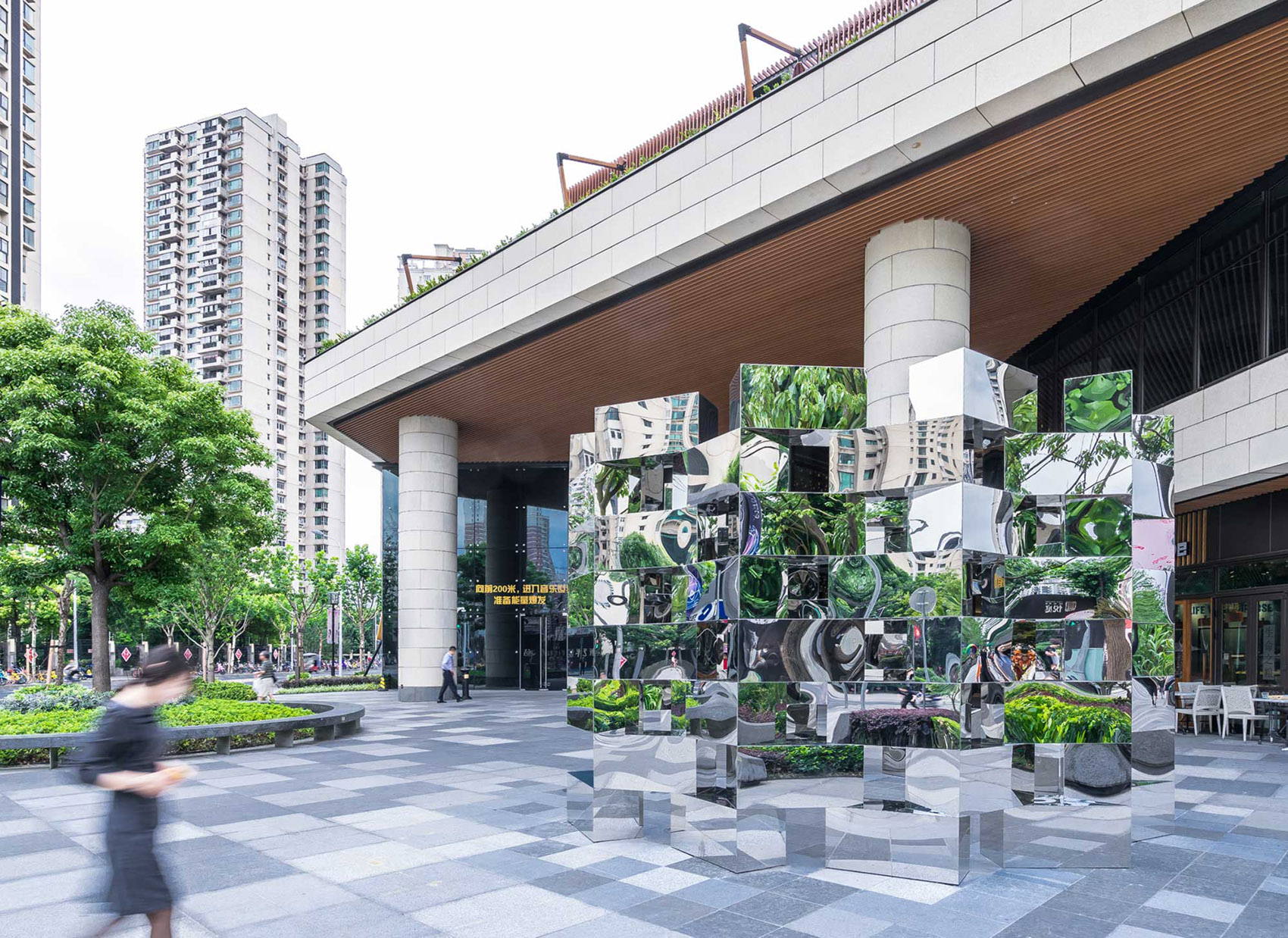
Orbital is a permanent public sculpture by the San Francisco Bay Area studio FUTUREFORMS, completed in 2021 in Mission Bay, San Francisco. About 33 feet tall, it rises on three coiled legs that twist up into a crown. The outside is a reflective skin of 316 marine-grade stainless steel panels; the inside is lined with colour-anodized aluminum shingles, and at night the whole piece glows like a lantern. It is one of the clearest recent examples of digital design and digital fabrication coming together in public art.
This is an independent appreciation. Elite Fixtures did not design, fabricate or install Orbital. The work is by FUTUREFORMS. Photographs of the work are on the studio's Orbital page; the illustrations in this article are our own.
At a glance
| Detail | Information |
|---|---|
| Work | Orbital |
| Studio | FUTUREFORMS, led by Jason Kelly Johnson and Nataly Gattegno |
| Completed | 2021 |
| Location | Pierpoint Lane and Bridgeview Way, Mission Bay, San Francisco |
| Commissioned for | The entrance plaza of Uber's headquarters; the buildings are now occupied by OpenAI |
| Size | 24 × 24 ft footprint, about 33 ft tall |
| Materials | 316 stainless steel skin, stainless steel tube skeleton, colour-anodized aluminum interior shingles |
| Structural engineer | Arup |
| Art consultant | Dorka Keehn |
| Fabrication | Olson Steel (skeleton), Seaport Stainless (stainless skins), Neal Feay (anodized shingles), with Stand Sheet Metal |
| Recognition | Honorable Mention, Fast Company Innovation by Design Awards, 2022 |
The studio
FUTUREFORMS was founded in 2009 by Jason Kelly Johnson and Nataly Gattegno. The studio works between art, architecture and technology, and its public works are known for what it calls digital craft: forms designed with computational tools and built from many custom, digitally cut parts. Besides Orbital, its recent work includes Weatherscape, a 70-foot canopy of stainless steel, acrylic and aluminum on the terrace of La Nube, the children's science museum in El Paso, completed in 2024.
The idea: a garden folly for the future
The studio describes Orbital as a contemporary garden folly: a structure built for delight in a landscape, in the tradition of the ornamental pavilions of older European gardens. The artists framed the project around a question: how can art express optimism about the future while bringing people into public space? Their answer is a creature-like form that seems to grow out of the plaza, with an interior you can step into.
The outside and inside are deliberately different. Outside, the tessellated stainless skin reflects the sky, the buildings and the people around it. Inside, the colourful shingles are soft and tactile at close range. After dark, light passes through the structure and the sculpture becomes what the studio calls a lantern in a garden.
How it was built
Metal Construction News published a detailed account of the build, which is rare for public art and worth reading in full. The main points:
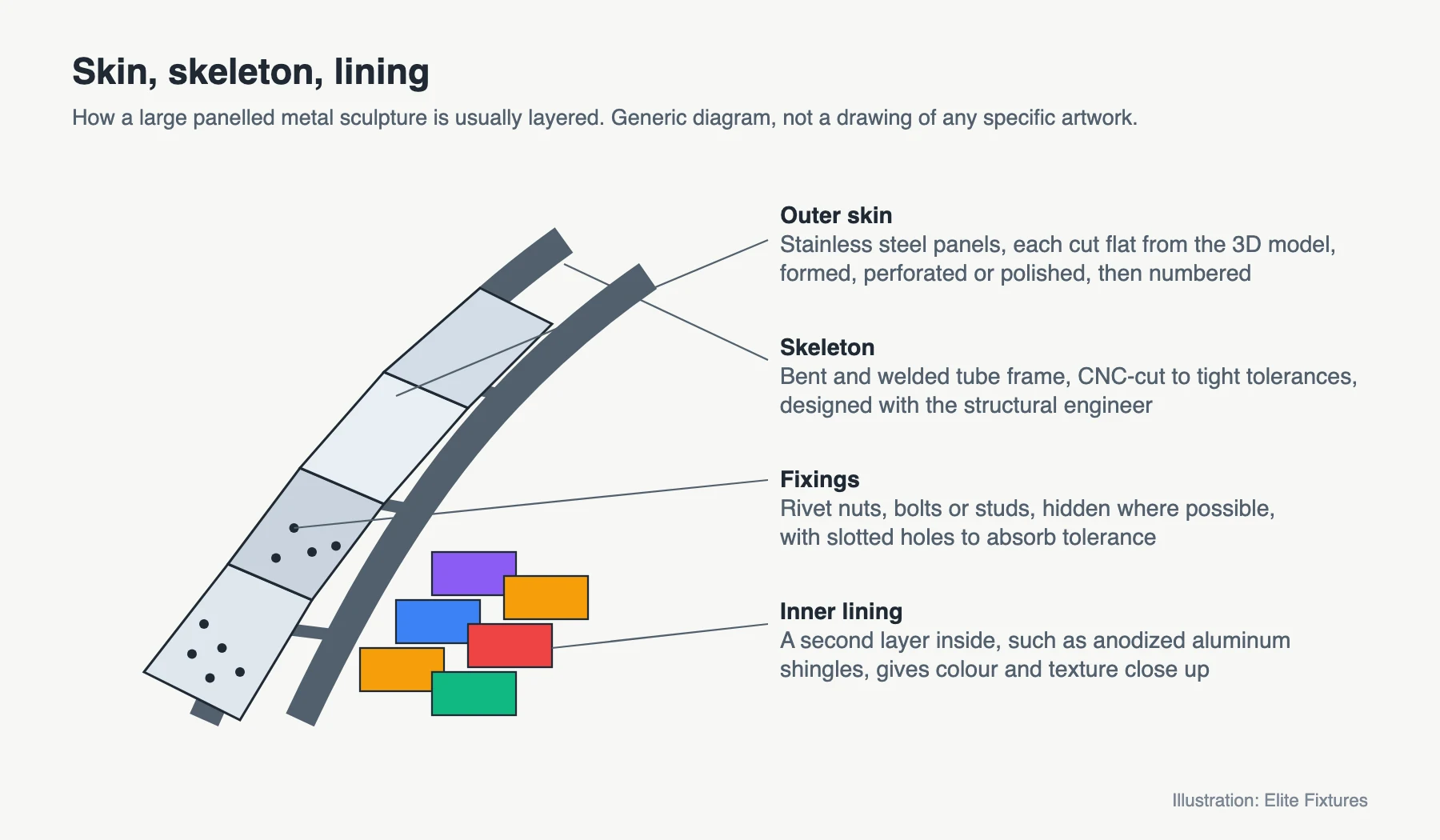
- Skeleton: Olson Steel of San Leandro, California, fabricated and installed the 33-foot stainless steel tube skeleton, made of more than 600 tube parts, CNC-cut to a tolerance of 1/8 inch. It forms the three legs and the crown.
- Outer skin: Seaport Stainless of Richmond, California, produced most of the 316 marine-grade stainless steel sheet-metal parts.
- Inner shingles: Neal Feay of Santa Barbara made the colour-anodized aluminum shingles.
- Processes: laser cutting, bending, rivet nuts, CNC cutting and graining, anodizing, welding and bolting.
- Engineering: Arup was the structural engineer.
Jason Kelly Johnson described the two skins as geometrically similar but made of different materials, one tessellated and one shingled. That split is what gives the piece its double character.
Why this kind of sculpture is hard to build
We fabricate stainless steel and aluminum sculpture, so we look at a project like Orbital from the workshop floor. A few things stand out.
Thousands of unique parts
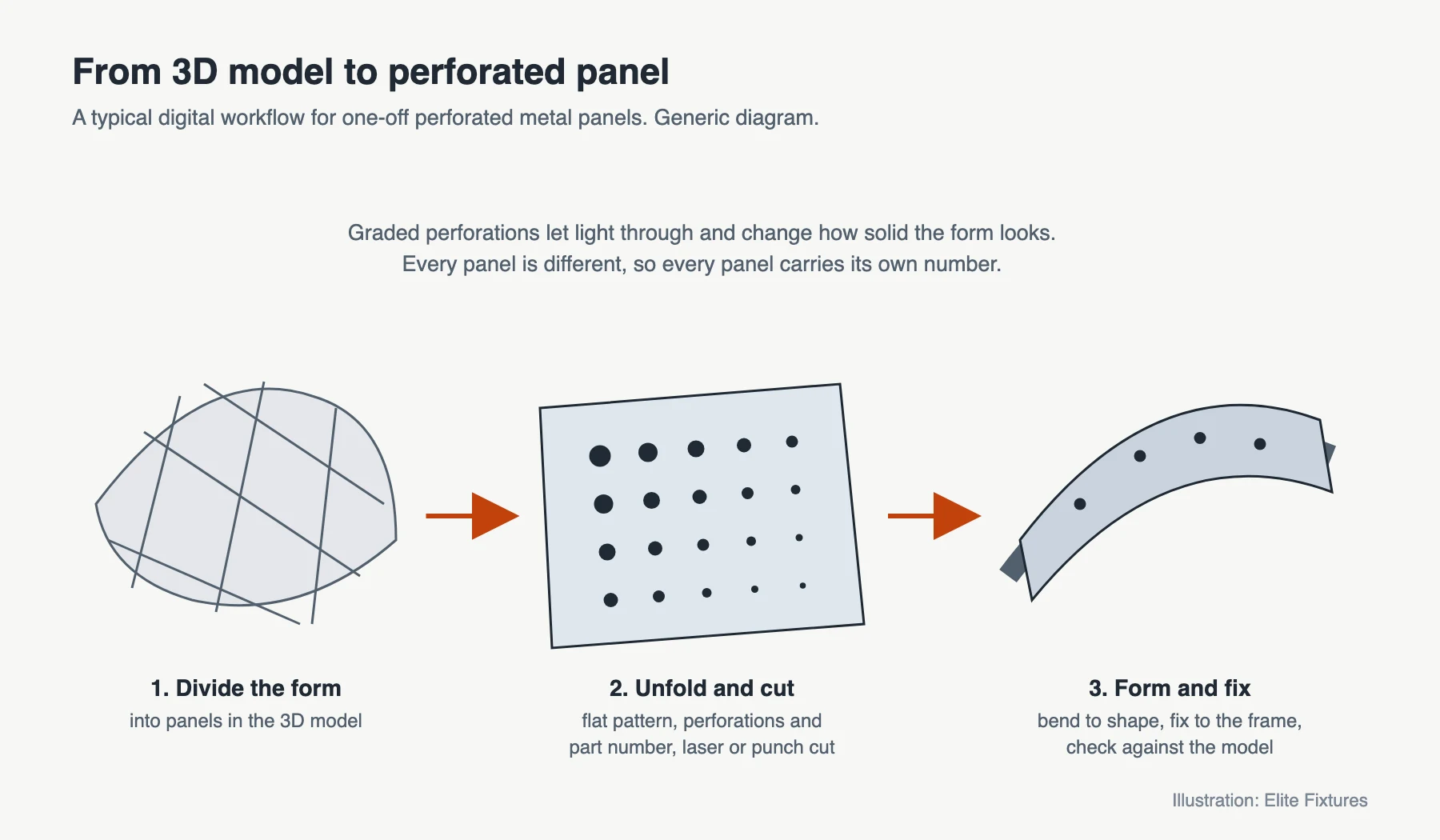
When a form is designed digitally, almost every panel is different. Each one has to be unfolded from the 3D model, cut, formed and numbered, and then installed in the right place. The data management is as important as the metalwork: a single mislabelled panel can stop an installation crew.
Tolerances add up
A tube skeleton cut to 1/8 inch sounds precise, but across a 33-foot structure small errors add up. Panel fixings usually include slotted holes or adjustable brackets so the skin can be aligned on site, and the skeleton is often trial-assembled before it ships.
Materials chosen for the climate
San Francisco's damp, salty air is hard on metal. That is why the skin is 316 stainless steel, which resists chloride pitting better than the more common 304, and why the interior colour comes from anodized aluminum rather than paint, since anodizing is part of the metal surface and does not peel.
Two skins, two trades
Stainless sheet work, tube fabrication and aluminum anodizing are different specialties. Orbital split them across several shops. Coordinating them through one digital model, with the structural engineer and the artists checking the details, is what made the project possible.
If you are commissioning a digitally fabricated sculpture
- Bring the fabricator into the model early. Panel sizes, sheet widths, bend limits and fixing details all shape the design.
- Agree on a numbering and data system. Every part should trace back to the model and to its place on site.
- Choose materials for the climate. Coastal and road-salt sites call for 316 stainless and finishes that won't peel.
- Plan for light. If the piece should glow at night, design the lighting and maintenance access with the structure.
Elite Fixtures fabricates stainless steel and aluminum sculpture from 3D models and drawings supplied by artists and design studios. For another mirror stainless work, see our article on Arnaud Lapierre's Ring • Chain.
FAQ
What is Orbital by FUTUREFORMS?
Orbital is a permanent public sculpture by the studio FUTUREFORMS, completed in 2021 in Mission Bay, San Francisco. About 33 feet tall, it has three coiled legs that rise into a crown, a reflective skin of 316 stainless steel and an interior lined with colour-anodized aluminum shingles. The studio describes it as a contemporary garden folly.
What is Orbital made of?
Orbital is made of a stainless steel tube skeleton of more than 600 parts, an outer skin of 316 marine-grade stainless steel sheet-metal panels, and interior shingles of colour-anodized aluminum. The materials were chosen for San Francisco's damp, salty air. Arup was the structural engineer.
Who fabricated Orbital?
Several shops fabricated Orbital, according to Metal Construction News. Olson Steel made and installed the stainless steel tube skeleton, Seaport Stainless produced most of the 316 stainless steel skins, and Neal Feay made the anodized aluminum shingles. Stand Sheet Metal of San Francisco also worked on the project.
Where is Orbital in San Francisco?
Orbital stands at Pierpoint Lane and Bridgeview Way in Mission Bay, San Francisco, at the entrance plaza of the headquarters built for Uber and now occupied by OpenAI. It was completed in 2021 and is a permanent installation.
Sources
- Orbital, FUTUREFORMS
- Editor's pick: contemporary metal folly, Metal Construction News
- FUTUREFORMS pushes the edge of public art with Orbital and Weatherscape, Daily Commercial News
- FUTUREFORMS explores digital craft in public art, DesignArcus
- Digital fabrication and metal materials shape interactive public installations, MaterialDistrict
- Weatherscape, FUTUREFORMS
About this article
Elite Fixtures was not involved in creating Orbital. We wrote this piece as an appreciation of the work and an explainer on the craft behind digitally fabricated metal sculpture. Photographs of Orbital are published by FUTUREFORMS on its website; the diagrams here are our own and do not depict the work.
Interested in a work by FUTUREFORMS? Commissions go directly through the studio: futureforms.us. Elite Fixtures is a fabrication partner: we build work that artists and designers have already designed, and we don't create original artworks or make reproductions of existing ones. If you have your own concept for a large metal piece, talk to our team about fabrication.