Casework is the cabinet part of a project — the boxes: base units, upper units, storage cabinets, counters with doors and drawers, often built to repeatable modular sizes. Millwork is the wider category that casework sits inside: all the wood and panel work fabricated in a shop to a project's drawings, including panelling, trim, reception desks, feature walls and stair parts as well as the cabinets.
Put simply, all casework is millwork, but most millwork is not casework. When a specification separates the two words, it is usually separating repeatable storage units from one-off architectural features — because they are priced differently, drawn differently and sometimes bought from different suppliers.
Comparison at a glance
| Casework | Millwork | |
|---|---|---|
| What it is | Cabinet boxes and storage units | All shop-fabricated wood and panel work |
| Typical items | Base and upper cabinets, drawer banks, lockers, storage walls, service counters | Casework plus reception desks, panelling, trim, feature walls, doors and frames, handrails |
| Repeatability | High — often modular, same box repeated | Low to none for feature items |
| Dimensions | Standard widths, depths and heights where possible | Whatever the drawings say |
| Engineering effort | Low per unit once the type is drawn | High per item |
| Cost per unit | Lower, and drops with quantity | Higher, driven by detail |
| Lead time driver | Volume and finish batching | Drawing approval and detail complexity |
| Common finishes | High-pressure laminate, thermofoil, painted MDF | Laminate, wood veneer, paint, metal, glass, solid surface |
| CSI location | Division 06, casework sections | Division 06, architectural woodwork sections |
What is casework in construction
Casework in construction means the manufactured cabinet units that provide storage and work surface. The defining characteristic is the box: a carcass of panel material, with a face frame or frameless front, fitted with doors, drawers, shelves and hardware.
Casework is described in two ways. Modular casework uses a set of standard box sizes — a 900 mm base with two doors, a 450 mm drawer bank, a 600 mm upper — combined into runs. Custom casework means boxes built to dimensions that suit the room rather than the catalogue. Both are shop-built; the difference is whether the sizes come from a standard set.
You see heavy casework packages in schools, labs, clinics, back-of-house areas and any space where the requirement is storage capacity rather than visual impact. Our breakdown of commercial casework types covers the material and grade choices inside that category.
What millwork covers that casework does not
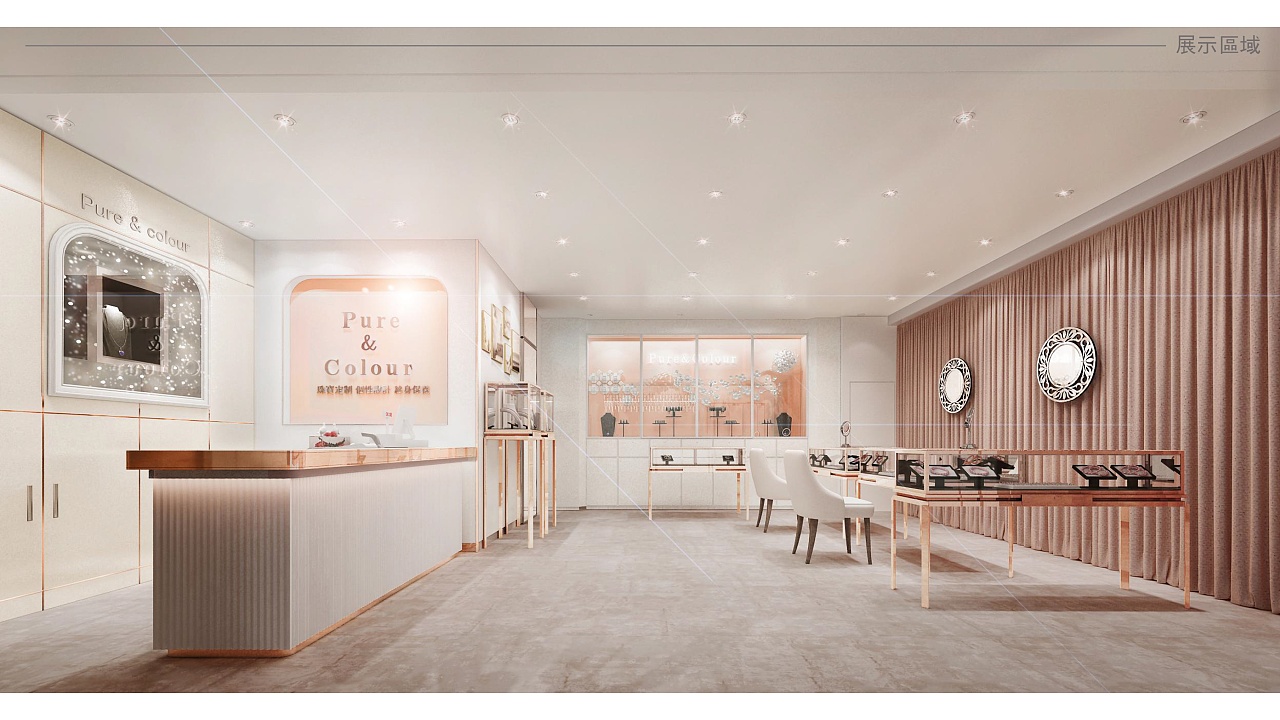
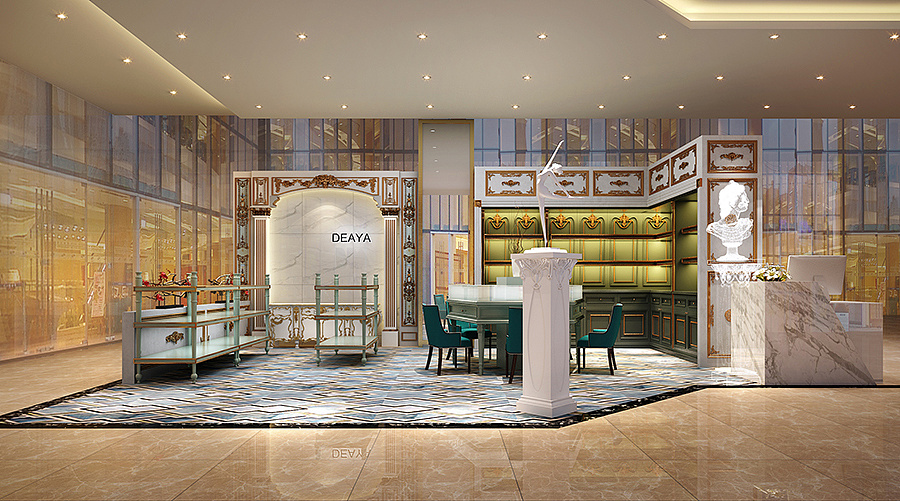
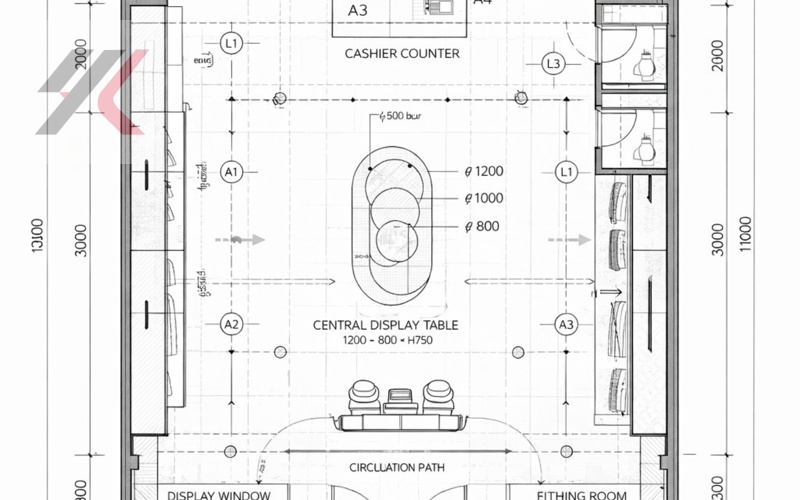
Millwork picks up everything architectural. On a retail store that includes the cash wrap, the illuminated wall systems, the display cases with glass and lighting integrated into the carcass, the fitting-room surrounds, and the bulkheads and closure panels that make a shop-built package sit tight to an imperfect building. On a café it includes the front counter with its equipment cut-outs and its customer-side cladding — see café counters for what that scope usually contains.
The full definition and the boundary against carpentry and furniture is set out in what is millwork in construction.
When a spec calls for one or the other
Read the specification section titles, not the drawings, to work out what the design team intends.
- A section for plastic-laminate-clad casework or wood casework signals a storage-driven package. Expect schedules of cabinet types, a hardware list, and a request for a typical unit detail rather than a detail of every cabinet.
- A section for interior architectural woodwork signals feature work. Expect full-size details, reveal dimensions, tolerances for alignment, and a requirement for veneer sequencing or grain matching.
- Both sections in one project means the design team has deliberately split the package. That is a signal about where the budget is: the architectural section carries the money.
Also read the grade. The architectural woodwork standards used in North America describe three quality levels — Economy, Custom and Premium — covering allowable tolerances, joinery methods, materials and finish quality. A casework section at Economy grade and an architectural woodwork section at Premium grade in the same project are two different purchases, even from the same shop.
Cost differences
Casework is cheaper per linear foot and gets cheaper with quantity. The box is engineered once, nested once, and cut in a batch. Twenty identical base cabinets cost far less than twenty different ones, and the saving is real: less drawing time, less setup, fewer offcuts, one finish batch.
Millwork feature items are priced closer to one-off fabrication. Cost drivers, in order:
1. Curves and non-orthogonal geometry. A curved front means a formed substrate, more layers, more sanding, more finish work. 2. Face material. Sequence-matched veneer costs more than laminate in material, and much more in labour, because panels have to be laid out and cut in order. 3. Integrated services. Lighting, power, data, sinks and equipment cut-outs each add coordination and shop labour. 4. Finish system. A high-gloss or multi-coat paint finish needs a controlled booth, cure time and rework tolerance. 5. Tolerance. Tight reveals and continuous alignment across a long run mean more careful fabrication and more careful installation.
On most fit-outs, casework is the larger quantity and the smaller share of the millwork budget. The reception desk that is one item out of sixty can be ten to twenty percent of the package value.
Lead time differences
Both start the same way: nothing is cut until drawings are approved. After that the two diverge.
Casework batches well. Once the cabinet types are approved, a long run of similar boxes moves through cutting, edgebanding and assembly at a predictable rate, and the finish is usually a factory-applied laminate that needs no cure time.
Feature millwork is gated by the slowest step, and that is often the finish. Paint and stain systems need cure time that cannot be compressed. Veneer needs layout before cutting. Curved substrates need forming and sanding before anything else can happen. A single feature wall can sit on the critical path for the whole package.
This is why an experienced fabricator will ask to release the drawings in stages — approve the casework first so it can start, keep working on the desk. We confirm dates only after approval; the stages are set out on our lead-time page.
How they appear in a CSI spec
Both live in Division 06 — Wood, Plastics, and Composites, and on most projects in the 06 40 00 group for architectural woodwork. Typical arrangement:
- 06 41 00 Architectural Wood Casework — the cabinet boxes, with unit schedules and hardware
- 06 42 00 Wood Panelling — wall panelling systems and feature walls
- 06 43 00 Wood Stairs and Railings — treads, risers, handrails, guard infill
- 06 46 00 Wood Trim — base, casing, mouldings, closure pieces
Countertops sometimes appear in Division 06 and sometimes in Division 12 (Furnishings), depending on material. Stone tops usually move to Division 09 or a separate stone section, with Division 06 responsible only for the substrate and the blocking. Confirm which section carries the top before you price it; it is the most commonly double-counted or missed item in a millwork tender.
How they get combined on a real job
Very few projects buy these separately, and there is a reason. Where a run of casework meets a feature millwork element — a laminate storage wall butting into a veneer reception surround — the joint is the risk. Two suppliers means two sets of tolerances, two delivery dates and an argument about the filler piece.
The practical approach is one package, one set of shop drawings, one installer, with the grade differentiated inside the package rather than split between vendors. That way the shop that draws the desk also draws the cabinet run next to it, and the transition detail is somebody's responsibility.
For our own projects, that package is fabricated at our factory in Huizhou, Guangdong. In the Greater Toronto Area — Toronto, Markham, Scarborough, Mississauga, Vaughan and Richmond Hill — we design, build and install, with $2,000,000 commercial general liability insurance and WSIB coverage for Ontario site work. Outside Canada we fabricate, crate and ship by sea, and the client's contractor installs. Scope questions are answered on our FAQ page, and the fixture range is on the store fixtures page.