
Planning a watch counter around the sale
A watch sale takes longer than a jewelry sale. The customer tries pieces on, compares two or three, and often sits down. That makes the counter a working surface as much as a display. Standing counters run 900 mm to 1000 mm high; seated consultation positions drop to around 750 mm with stools both sides and a clear knee space cut into the cabinet.
Depth of 550 mm to 600 mm suits watch trays, which are wider than ring trays and need room for a strap to lie flat rather than curl. Leave a clear staff aisle of 900 mm to 1100 mm behind the run, or two staff cannot pass while one has a drawer open.
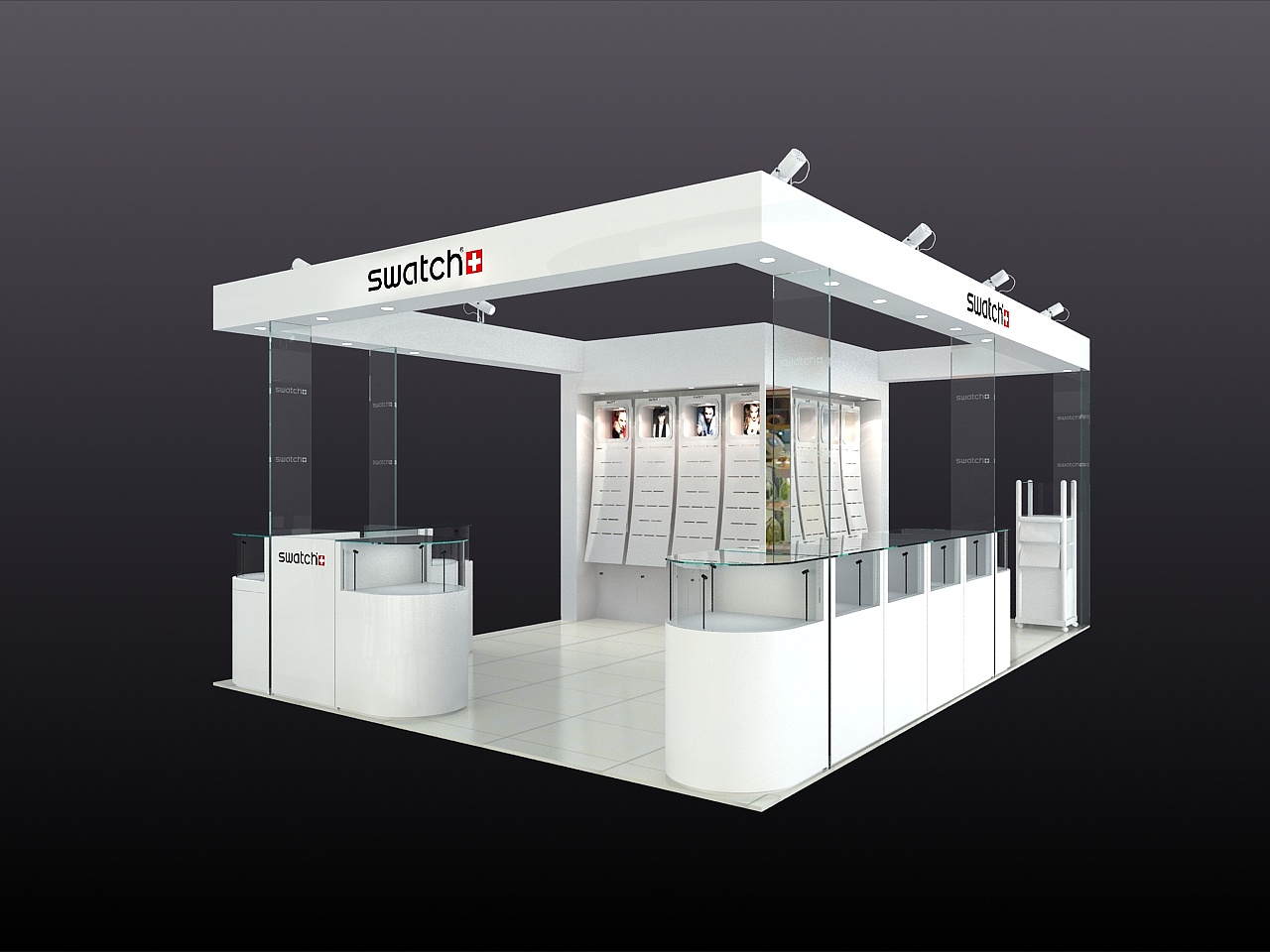
Decide early whether the counter is brand-zoned. Mono-brand shop-in-shop zones usually come with fixture guidelines covering panel sizes, logo positions and finish codes, and those constraints drive the cabinet. Send any brand specification with the enquiry rather than after drawings. More formats are in our watch display category.
- Standing counter: 900-1000 mm; seated consultation: around 750 mm
- Depth 550-600 mm so straps lie flat in the tray
- Watch trays commonly hold 6, 8, 10 or 12 pieces
- Allow a clear, lit writing surface for the transaction
Tray systems, cushions, and spacing
Watch presentation is about spacing. A crowded tray makes every piece look cheaper and makes it harder for a customer to focus on one. Cushion size has to suit the strap type: a leather strap sits differently from a steel bracelet, and a bracelet needs a wider cushion so links do not splay.
Stepped risers help more here than in jewelry, because a dial is read from the front. Raising the back row 40 mm to 60 mm turns a flat grid into something a standing customer can scan. Removable risers let a store rearrange for a new collection without rebuilding the cabinet.
Linings in suede or microfibre come in grey, cream, black and brand colours. Grey is safest for steel and white metal, cream warms yellow gold, black is dramatic and shows dust immediately. Order spare trays and cushions with the counters, because lining batches vary and an odd tray in a run is obvious. Cushions also compress with use, and a tired cushion lets a piece sit at an angle a customer will notice.
Lighting for dials and cases
Watch dials are glossy sapphire or mineral crystal and polished cases are effectively small mirrors, so glare is the central lighting problem. A badly placed spot puts a bright reflection straight across the dial. The fix is diffused fill plus carefully aimed accent, not more brightness.
We run LED strip in a recessed aluminium channel with a diffuser for the base layer, usually along the front lip so light travels back across the trays rather than straight down onto the crystal. Accent spots come from a steeper angle onto hero positions to bring out case polish and bracelet links.
Colour temperature between 3000K and 4000K covers the category: 3000K warms rose gold and leather, 3500K to 4000K makes steel and white gold look crisp. Keep one temperature across the whole watch zone. Drivers go in a ventilated base section, because a sealed cabinet full of LED heat is uncomfortable for staff and shortens component life. The same approach applies to our museum artifact display showcase.
Glass, locking, and secure handling
Glass tops are usually 8 mm tempered, with 10 mm on longer unsupported spans. Low-iron glass is worth the upgrade here because the green cast of standard float sits directly over a steel bracelet and dulls it. Tempered glass cannot be cut or drilled after tempering, so every notch and lock cut-out is fixed at drawing approval.
Access is normally staff-side sliding or hinged doors with fixed glazing to the customer. Tubular locks are the usual upgrade over basic cam locks on high-value stock. Decide whether keying is alike across a run or separate per case before production, because rekeying later is slow.
Design the counter so a whole tray lifts out into a safe at close of business. That one operational detail does more for security than any cabinet feature, and it means staff are not handling pieces individually at the end of a long day. We can specify laminated glass and reinforced bases; we do not make burglary-resistance claims for any display counter.
Finishes, brand panels, and wear
Watch retail leans on veneer, sprayed lacquer and metal more than laminate. Veneer in walnut, oak or a stained figured timber reads as premium on customer-facing fronts, though it shifts slightly in colour over years under UV. Sprayed satin lacquer gives a seamless, colour-matched face; it repairs less easily than laminate but looks considerably better.
Trim is normally brushed or mirror stainless, or titanium-coated stainless in gold, champagne, rose or black. On the front edge, where customers lean and bracelets brush the counter, brushed hides marks far better. Mirror belongs on vertical surfaces and brand panels, not horizontal contact areas.
Brand panels are usually backlit acrylic or an applied metal logo on a solid ground. Backlit panels need their own driver and a service access route, so plan the panel and its wiring together. Artwork, logo files and colour references come from the brand; we build to the specification you supply.
Care, packing, and what to send for a quote
Glass on a watch counter is touched all day. Spray the cloth, not the counter, so cleaner does not run into the lighting channel or door track, and use microfibre rather than paper towel, which scratches glass over time. Suede trays are brushed or lint-rolled, never wet cleaned. Vacuum door tracks weekly, adjust soft-close hardware rather than forcing a dragging drawer, and keep spare LED strip and a driver from the original order, since batches are hard to match later. Common questions are on our FAQ page.
Counters ship fully assembled where size permits, with glazing, lighting and hardware fitted and tested at the factory. Each unit is foam-wrapped, corner-protected and crated in a wooden export crate; long runs split into sections with a defined join, and loose glass travels in dedicated crates with interleaving. Production is in Huizhou, China, with sea freight to North America as the normal route - our factory page shows how units are built and packed. Confirm the crate fits the loading route, the lift and every corner before ordering.
For a quote, send the run dimensions or store plan, how many watches you need to display, tray and cushion types, whether you want seated consultation positions, security requirements, finish and trim direction, any brand fixture specification, and the destination city and quantity. Watch counters are usually quoted with wall cabinets, a cash wrap and often a custom jewelry showcase counter in the same finish family. Lead time depends on finish complexity, brand approvals and order size, and is confirmed after drawings are approved - see our lead time page.