
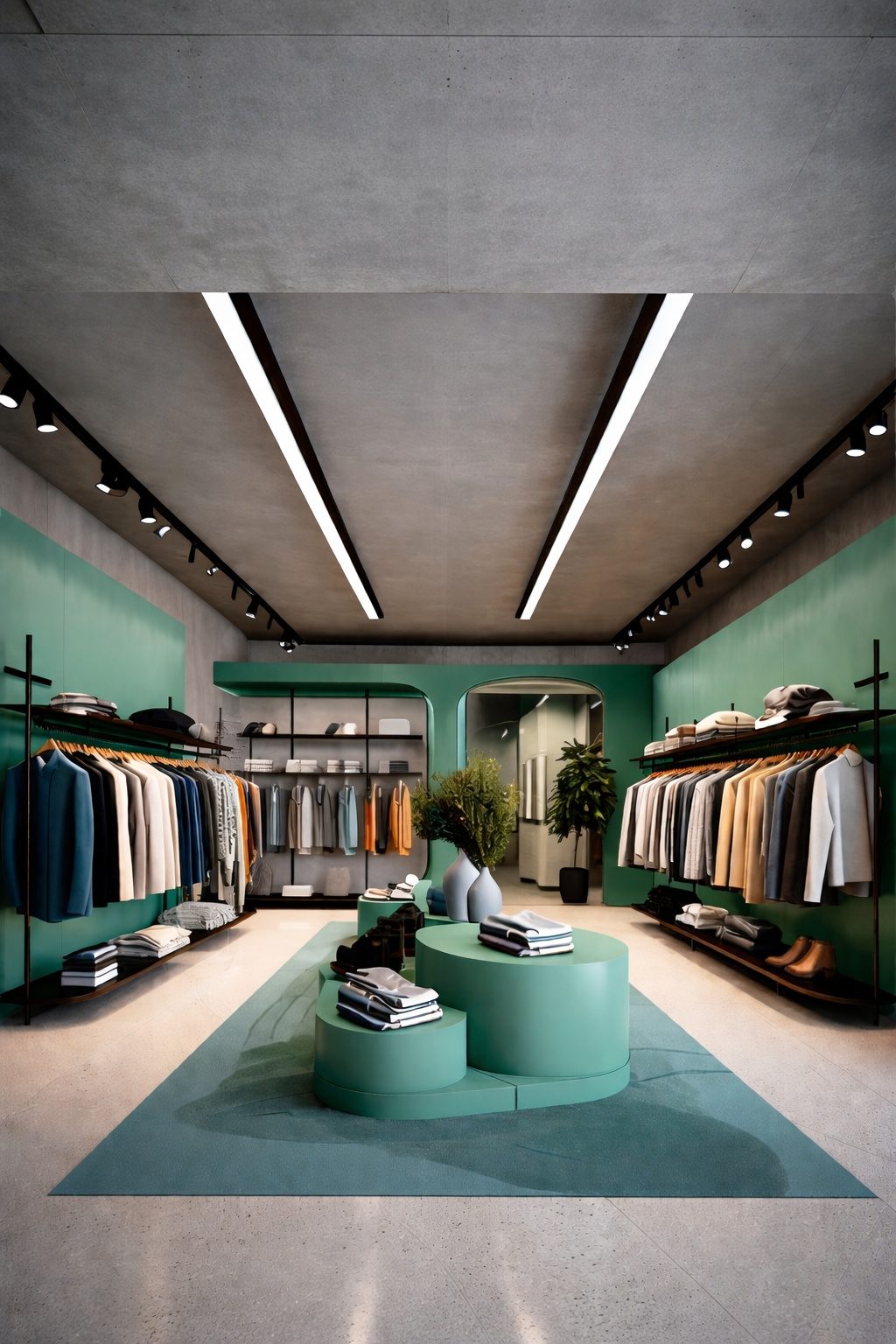
Rail heights and garment length
The reason to choose a double rail is density, and the reason density fails is garment length. Two rails only work if the lower rail clears the floor with the longest garment that will hang on it. Shirts and folded-over trousers are comfortable on a double rail; coats, dresses and maxi lengths generally are not, and forcing them onto a double rail puts hems on the floor.
As a working rule, we set the upper rail so the customer can lift a hanger off without reaching over their head, and we set the lower rail from the measured length of the longest garment plus a clearance allowance. Send us the actual garment lengths rather than a category name; a boutique blouse and an oversized shirt can differ by 200 mm.
Where a collection mixes lengths, a better answer is often one double-rail unit for short goods next to a single high rail for long goods, sharing the same finish and base detail. The full range of clothing racks is built so mixed configurations still look like one family on the floor.
- Longest garment length per rail, measured on the hanger
- Upper rail set for comfortable unaided reach
- Floor clearance under the lower rail for hems and cleaning
- Hanger type and hook opening, which sets rail diameter
Load, rail span and how the rack stays straight
A rail sags for two reasons: the span is too long, or the section is too light for the load. We size the rail tube from the unsupported span and the expected weight per linear metre, and where a boutique wants a long clean run we add a concealed centre support rather than thickening the tube until it looks industrial.
Heavy outerwear, denim and knitwear load a rail far more than light apparel. Tell us what the rack will actually carry at peak, not the average. We do not publish a single load figure because it changes with span, tube section and bracket spacing, and any number quoted without those three inputs is meaningless.
Stability is the other half. A tall double rail with a narrow base tips when a customer pulls a garment from one end. We use a weighted base, a wider footprint, or a T-base with the mass low down, and we check the geometry against the loaded condition rather than the empty one.
Casters versus fixed feet
Casters are chosen by stores that reset the floor weekly and by shops that push fixtures aside for events. They cost floor stability, so a caster rack should be specified with locking wheels on at least two corners and a slightly wider base than the fixed-foot version.
Caster quality matters more than the rack. Cheap wheels flat-spot, pick up thread and grit, and mark a polished floor. We specify a wheel material matched to the floor: softer treads for hard stone and sealed concrete, harder treads for carpet tile. Ask for the wheel type in writing; it is one of the easiest places for a supplier to save money at your expense.
Fixed feet give a cleaner line and a more premium look, and they are what most boutiques choose for a feature rack near the entrance. Adjustable glides are still needed because retail floors are rarely level, and a rack that rocks reads as cheap no matter how good the finish is.
Powder coat and where wear actually happens
Powder coating is durable across a flat surface and vulnerable at contact points. The places that fail first are the rail where hangers slide, the base edge where vacuum cleaners and shoes hit it, and the joint where the upright meets the base. Those three spots decide how the rack looks after two years.
We prepare steel properly before coating, keep film thickness consistent on edges, and specify a harder finish or a stainless or chrome insert on the rail itself where hanger traffic is heavy. On black matte finishes, which show everything, we usually recommend the metal rail insert rather than a coated rail.
At the base, a stainless kick strip or a slightly recessed foot keeps the coating out of the damage zone. Touch-up paint in the exact batch colour should be supplied with the order; ask for it, because matching a matte black years later is close to impossible.
- Metal or chrome insert on the rail where hanger traffic is constant
- Kick protection or recessed foot at the base edge
- Consistent coating on edges, not just flat faces
- Batch-matched touch-up supplied with the shipment
Mixing hanging and folded goods
Most boutiques do not sell only hanging goods. A double rail carries volume but tells no story, so it works best paired with a surface that shows folded goods, accessories or a styled look. We frequently add a base shelf or a timber deck under the lower rail, which turns wasted floor into a folded-goods position without adding footprint.
An end panel or a small bracket-mounted shelf at the rack end gives a place for a sign, a size guide or a single styled item. That end position is what makes a dense rack readable from across the floor.
On a full floor set, the rack usually sits between wall bays and a centre table. If the store is also using a wall system, keeping the same finish and the same signage holder across the modular gondola store system and the racks is what makes a mixed floor look designed rather than assembled.
Knock-down packing and sea freight
Racks are fabricated, coated and trial-assembled at our factory in Huizhou, China, then packed knock-down. Uprights, rails, bases and shelves ship flat in cartons with foam or film on every coated surface, because powder coat damage in transit is the main risk with metal fixtures. Fasteners are bagged per unit, not loose in the carton.
Knock-down packing cuts shipping volume substantially, which matters on sea freight to North America where you pay for cubic space. For small orders or for a single feature rack, assembled shipping is possible and we will quote both so the trade-off is visible.
Assembly on site is typically a tool-light job: uprights into the base, rails dropped into brackets, glides levelled. We supply an assembly sheet per model and spare fasteners. Lead time depends on quantity, finish colour and coating schedule, and is confirmed after drawings are approved; the lead time guide explains the stages.
What to send for an accurate quote
Send the quantity, the longest garment length, whether you want casters or fixed feet, the finish direction, and a floor plan or a photograph of the space. If you have a reference image of a rack you like, send it; it resolves proportion questions faster than a written description.
Tell us whether this rack is a one-off or part of a store package. If it is part of a package, we will quote the rack against the rest of the fixture family so finishes, signage holders and base details match. For a full apparel floor, it is usually cheaper to specify the whole family at once than to add matching pieces later. The FAQ page covers ordering and sampling questions.